Adaptive Learning Platforms: How AI Powers Personalized Education in April 2026
Adaptive Learning Platforms: How AI Powers Personalized Education in April 2026
Adaptive learning platforms powered by AI personalize education by adjusting content, pacing, and difficulty in real time. Learn how AI drives results in April 2026.
Your team moves through training at completely different speeds. Some finish in minutes. Others take far longer and still struggle to pass. That gap points to a structural issue, not a talent one. Adaptive learning platforms powered by AI adjust each person’s path based on what they already know and how they learn, so time isn’t wasted on content that adds no value. The result is faster progress, stronger retention, and a system that adapts to the learner instead of forcing everyone into the same pace.
TLDR:
AI adapts content, pacing, and difficulty in real time based on learner behavior and performance.
Adaptive systems cut time-to-competency and training costs by skipping what learners already know.
Corporate adoption grows at 20.7% annually as enterprises replace one-size-fits-all training.
Real results: Wolters Kluwer upskilled 30,000 employees in 3 weeks, saving $1.62M.
Some solutions deliver adaptive learning directly through Teams, Slack, and SMS, meeting employees where they already work.
What Is Adaptive Learning and How Does It Work?
Adaptive learning adjusts to each learner instead of making every learner conform to the same fixed path. Instead of a uniform sequence of content, adaptive systems track how each person responds and modify what comes next based on that data.
The mechanics rely on algorithms that read performance signals in real time. Get a concept right on the first try? The system moves you forward faster. Struggling with a skill? It slows down, reframes, and reinforces before advancing. Pacing, difficulty, and content format shift continuously based on individual behavior.
AI makes this work at scale. A human tutor adapts to one student at a time. An AI-driven system does it for thousands simultaneously, reading response patterns, time-on-task, error rates, and assessment scores to build a unique path for each learner.
The Role of AI in Powering Adaptive Learning Experiences
Three AI capabilities do most of the work in adaptive learning: pattern recognition, predictive modeling, and content routing.
Pattern recognition processes behavior signals as learners move through content. Time spent per question, error frequency, skip patterns, and response confidence all feed into a model that builds a real-time picture of what someone knows versus what they think they know. Those two things are often different.
Predictive modeling takes that picture and flags gaps before they become visible failures. The system anticipates where comprehension is likely to break down and adjusts proactively, without waiting for a failed assessment.
Content routing then decides what comes next. Harder questions, alternate explanations, review loops, or a skip ahead. All of it happens without human intervention, across thousands of learners at once.
Human tutors do this naturally with one student. AI does it at scale, which is the part that actually changes outcomes organizationally.
Key Benefits of Adaptive Learning for Students and Organizations
The adaptive learning market reached $4.64 billion in 2025 and is projected to grow at a 23.40% CAGR through 2035. That growth signals something real: organizations are seeing returns worth investing in.
For Learners
Faster progress by skipping material they've already mastered
More time on concepts that genuinely need reinforcement
Higher retention because the system spaces and revisits based on individual gaps
For Organizations
Measurable reduction in time-to-competency
Lower training costs as content scales without added headcount
Better visibility into where knowledge gaps exist across teams
When training respects existing knowledge and stops wasting people's time, engagement follows. That alone solves a problem most training programs never crack.
How Adaptive Learning Works in K-12 and Higher Education
Schools face a fundamental tension: classrooms of 25 to 30 students with wildly different starting points, one teacher, and one pace. Adaptive systems don't replace teachers, but they give them something they've never had before: real-time data on exactly where each student is struggling.
K-12 Applications: In elementary settings, adaptive systems often focus on foundational literacy and math. A third-grader reading below grade level gets a different content path than one reading above it, without the stigma of being visibly separated from peers. At the middle and high school level, adaptive tools track skill gaps across subjects, flag at-risk students before grades reflect it, and help teachers target intervention where it's actually needed.
Higher Education: At the university level, adaptive learning has gained traction in high-enrollment introductory courses where personalization is otherwise impossible. A lecture hall of 300 students in Intro Biology gets one pace. An adaptive system gives each of those students a different one. Research from the Bill & Melinda Gates Foundation found that adaptive learning in higher education improved course outcomes and reduced time students spent on content they weren't ready for.
The honest challenge in both settings is implementation. Adaptive systems require clean data pipelines, teacher training, and content libraries built for branching delivery. Most schools aren't starting from a position where that infrastructure exists.
Adaptive Learning in Corporate Training and Employee Development
Corporate training has a well-documented problem: one-size-fits-all courses deployed to thousands of employees with different roles, experience levels, and existing knowledge. Most of it gets clicked through. Little of it sticks.
Adaptive learning changes the structure of that problem. A 10-year veteran and a new hire get routed through content calibrated to what they actually need. The veteran skips what they already know. The new hire gets reinforcement where gaps appear. Both finish faster and retain more.
The enterprise market is responding. Corporate and enterprise users are projected to grow at a 20.7% CAGR through 2030, the highest growth segment in the adaptive learning market.
Where It Shows Up in Practice
Sales onboarding that adjusts to product knowledge gaps per rep
Compliance training that skips sections employees can already show mastery of
AI upskilling programs that adapt based on current tool usage data
Manager development tracks that shift based on 360 feedback inputs
Employee time is finite and expensive. Every hour spent on content someone already knows is a cost with no return. Adaptive delivery stops that waste at the source.
Real-World Examples of Adaptive Learning Implementation
Three cases show what adaptive learning actually produces at scale.
Corporate Sales Enablement
Ecolab used AI-powered adaptive enablement to close product knowledge gaps across their sales team. The result: higher playbook adherence and strong year-over-year revenue growth. Content reached reps in the flow of work, adjusting to individual gaps instead of delivering the same course to everyone.
Enterprise AI Upskilling
Wolters Kluwer needed to upskill 30,000 employees across 13 languages in three weeks. Personalized delivery adapted to role and existing knowledge level. The outcome was 120% more AI usage and $1.62M saved.
Life Sciences Product Launches
Novartis ran 140 programs with 70,000+ enrollments in six months. Over 80% of reps immediately applied what they learned. Role-based personalization made that application rate possible at that scale.
Across all three: faster, cheaper, and measurably more effective than uniform delivery.
Comparing Adaptive Learning to Traditional Training Methods
Traditional training assumes everyone starts from the same place. They don't.
A fixed course delivers the same content at the same pace to a new hire and a decade-long veteran. One is overwhelmed. The other is bored. Neither outcome is useful.
Traditional Training | Adaptive Learning | |
|---|---|---|
Pacing | Fixed for all learners | Adjusted per individual |
Content path | Linear, uniform | Branched, personalized |
Gap detection | Post-assessment, reactive | Real-time, proactive |
Engagement | Low (avg. LMS completion: 8%) | Much higher |
Cost at scale | Increases with headcount | Scales without linear cost growth |
The average LMS nets a -40 NPS. Learners aren't the problem. The structure is.
Adaptive systems fix the structure. Content responds to behavior instead of ignoring it. That's a different category of solution, not a better version of the same one.
Technical Requirements for Implementing Adaptive Learning
Getting adaptive learning deployed requires more than picking a vendor. Four requirements tend to determine whether rollout succeeds or stalls.
Data infrastructure: The system needs clean, accessible learner data to route content effectively. Disconnected HR, LMS, and performance systems create gaps that undermine personalization from day one.
Integration layer: Adaptive tools must connect to where learning actually happens, whether that's a messaging tool, an LMS, or a CRM.
Content built for branching: Most existing content libraries are linear. Adaptive delivery requires modular content designed to flex by role, level, and knowledge state.
Change management: New systems fail without stakeholder buy-in. L&D teams, managers, and IT all need clarity on what changes and why.
Cloud-based deployment has largely replaced on-premises for new implementations, mainly because real-time data processing at scale requires infrastructure most organizations can't maintain internally. The tradeoff is data governance, which enterprise buyers should pressure-test before signing.
Challenges and Considerations When Adopting Adaptive Learning
Adopting adaptive learning is rarely the hard part. Making it stick inside an organization is.
Four challenges come up consistently across implementations:
Cost: Quality adaptive systems carry real price tags. Budget conversations get complicated when spend is split across HR, IT, and L&D with no shared owner.
Data privacy: Adaptive systems collect granular learner behavior data. GDPR, FERPA, and internal security policies create compliance questions that need answers before deployment, not after.
Integration complexity: Most organizations run fragmented tech stacks. Connecting an adaptive layer to HRIS, CRM, and existing delivery tools takes real engineering effort.
Change resistance: L&D teams built around traditional authoring workflows often push back. So do employees accustomed to just clicking through a course.
None of these are reasons to avoid adaptive learning. They're reasons to plan carefully before you start. The organizations that succeed treat implementation as a change management project, not a software purchase.
Bringing Adaptive Learning into the Flow of Work with Arist
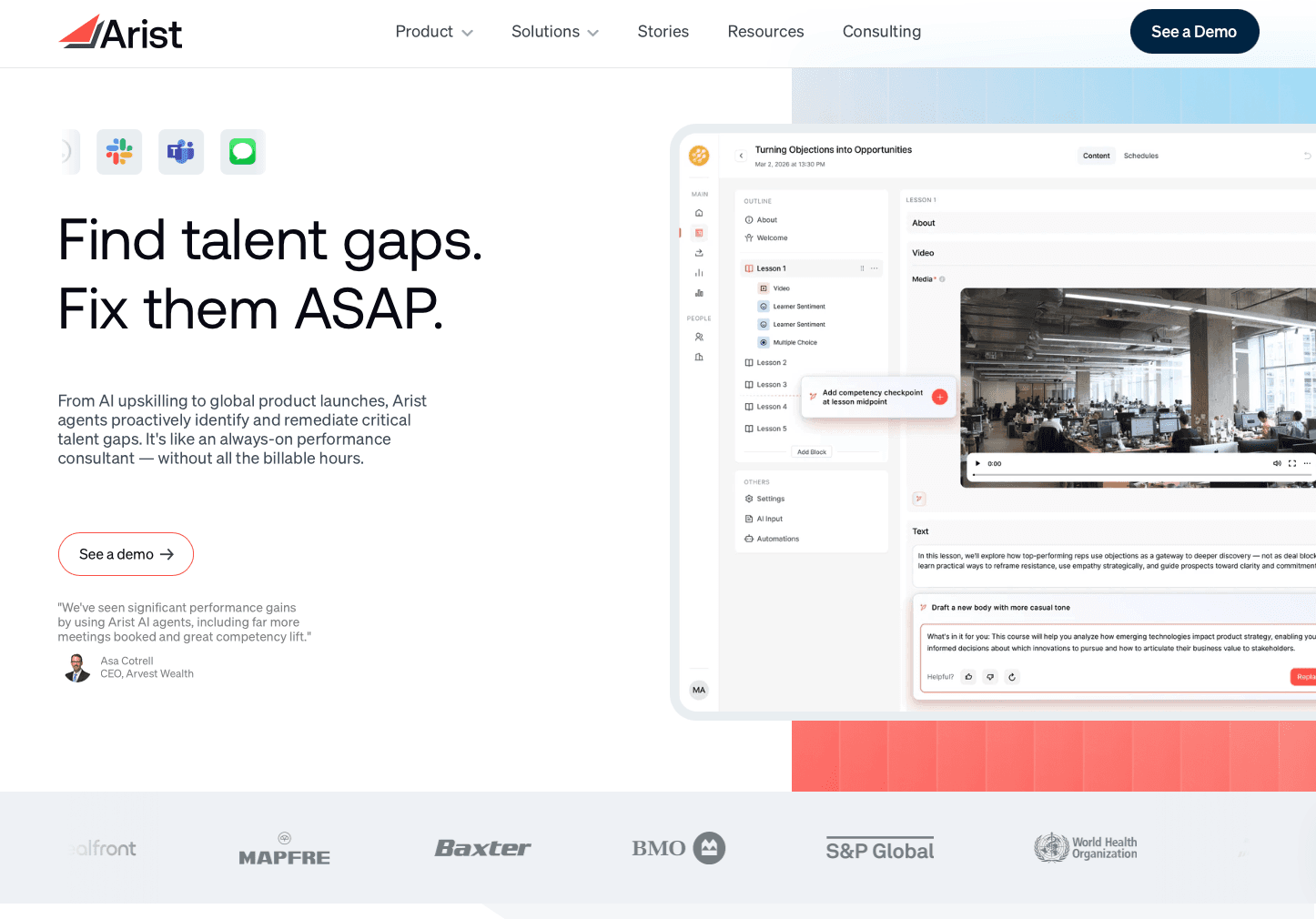
Most adaptive learning systems personalize content. Arist adapts the entire enablement workflow.
The difference matters. Knowing a knowledge gap exists is not the same as closing it. Arist's AI agents interview employees at scale, pull data from CRM and HRIS systems, build personalized content by role and level, and deliver it through Teams, Slack, or SMS. No separate login. No course catalog to browse. Learning arrives where employees already work.
The results reflect that approach. Wolters Kluwer upskilled 30,000 employees in three weeks. Novartis saw 80% of reps immediately apply what they learned. Medtronic tripled rep adoption.
"Bringing learning directly into the natural flow of their day makes development more accessible, relevant, and human." - Brian Wallace, Chief Talent Officer, Wintrust
Adaptive learning is only as useful as the system delivering it. If employees never see the content, personalization is irrelevant. We built Arist to solve that problem first.
FAQs
What's the difference between adaptive learning and traditional training?
Traditional training delivers the same content at the same pace to everyone, regardless of what they already know. Adaptive learning tracks individual responses in real time and adjusts pacing, difficulty, and content format based on actual performance, so each person gets what they need when they need it.
How does AI make adaptive learning work at scale?
AI processes behavior signals like time-on-task, error patterns, and assessment scores to build a real-time picture of what each person knows. It predicts where comprehension gaps will appear before they cause failures and routes content accordingly. It does for thousands of learners simultaneously what a human tutor can only do for one.
How quickly can organizations see results from adaptive learning?
Results depend on implementation scope and content readiness. Some organizations see measurable improvements in weeks. Wolters Kluwer upskilled 30,000 employees in three weeks with 120% more AI usage. Others take months if data infrastructure or change management creates bottlenecks.
Final Thoughts on Making Adaptive Learning Work
Most training still assumes everyone starts at the same point, even though they don’t. Adaptive learning platforms powered by AI remove that mismatch by routing content based on real gaps and actual performance. The final piece is delivery. If learning lives outside the tools employees already use, engagement drops before it starts. Arist brings adaptive learning into the flow of work through the channels people check every day, closing the gap between personalization and real adoption.
Your team moves through training at completely different speeds. Some finish in minutes. Others take far longer and still struggle to pass. That gap points to a structural issue, not a talent one. Adaptive learning platforms powered by AI adjust each person’s path based on what they already know and how they learn, so time isn’t wasted on content that adds no value. The result is faster progress, stronger retention, and a system that adapts to the learner instead of forcing everyone into the same pace.
TLDR:
AI adapts content, pacing, and difficulty in real time based on learner behavior and performance.
Adaptive systems cut time-to-competency and training costs by skipping what learners already know.
Corporate adoption grows at 20.7% annually as enterprises replace one-size-fits-all training.
Real results: Wolters Kluwer upskilled 30,000 employees in 3 weeks, saving $1.62M.
Some solutions deliver adaptive learning directly through Teams, Slack, and SMS, meeting employees where they already work.
What Is Adaptive Learning and How Does It Work?
Adaptive learning adjusts to each learner instead of making every learner conform to the same fixed path. Instead of a uniform sequence of content, adaptive systems track how each person responds and modify what comes next based on that data.
The mechanics rely on algorithms that read performance signals in real time. Get a concept right on the first try? The system moves you forward faster. Struggling with a skill? It slows down, reframes, and reinforces before advancing. Pacing, difficulty, and content format shift continuously based on individual behavior.
AI makes this work at scale. A human tutor adapts to one student at a time. An AI-driven system does it for thousands simultaneously, reading response patterns, time-on-task, error rates, and assessment scores to build a unique path for each learner.
The Role of AI in Powering Adaptive Learning Experiences
Three AI capabilities do most of the work in adaptive learning: pattern recognition, predictive modeling, and content routing.
Pattern recognition processes behavior signals as learners move through content. Time spent per question, error frequency, skip patterns, and response confidence all feed into a model that builds a real-time picture of what someone knows versus what they think they know. Those two things are often different.
Predictive modeling takes that picture and flags gaps before they become visible failures. The system anticipates where comprehension is likely to break down and adjusts proactively, without waiting for a failed assessment.
Content routing then decides what comes next. Harder questions, alternate explanations, review loops, or a skip ahead. All of it happens without human intervention, across thousands of learners at once.
Human tutors do this naturally with one student. AI does it at scale, which is the part that actually changes outcomes organizationally.
Key Benefits of Adaptive Learning for Students and Organizations
The adaptive learning market reached $4.64 billion in 2025 and is projected to grow at a 23.40% CAGR through 2035. That growth signals something real: organizations are seeing returns worth investing in.
For Learners
Faster progress by skipping material they've already mastered
More time on concepts that genuinely need reinforcement
Higher retention because the system spaces and revisits based on individual gaps
For Organizations
Measurable reduction in time-to-competency
Lower training costs as content scales without added headcount
Better visibility into where knowledge gaps exist across teams
When training respects existing knowledge and stops wasting people's time, engagement follows. That alone solves a problem most training programs never crack.
How Adaptive Learning Works in K-12 and Higher Education
Schools face a fundamental tension: classrooms of 25 to 30 students with wildly different starting points, one teacher, and one pace. Adaptive systems don't replace teachers, but they give them something they've never had before: real-time data on exactly where each student is struggling.
K-12 Applications: In elementary settings, adaptive systems often focus on foundational literacy and math. A third-grader reading below grade level gets a different content path than one reading above it, without the stigma of being visibly separated from peers. At the middle and high school level, adaptive tools track skill gaps across subjects, flag at-risk students before grades reflect it, and help teachers target intervention where it's actually needed.
Higher Education: At the university level, adaptive learning has gained traction in high-enrollment introductory courses where personalization is otherwise impossible. A lecture hall of 300 students in Intro Biology gets one pace. An adaptive system gives each of those students a different one. Research from the Bill & Melinda Gates Foundation found that adaptive learning in higher education improved course outcomes and reduced time students spent on content they weren't ready for.
The honest challenge in both settings is implementation. Adaptive systems require clean data pipelines, teacher training, and content libraries built for branching delivery. Most schools aren't starting from a position where that infrastructure exists.
Adaptive Learning in Corporate Training and Employee Development
Corporate training has a well-documented problem: one-size-fits-all courses deployed to thousands of employees with different roles, experience levels, and existing knowledge. Most of it gets clicked through. Little of it sticks.
Adaptive learning changes the structure of that problem. A 10-year veteran and a new hire get routed through content calibrated to what they actually need. The veteran skips what they already know. The new hire gets reinforcement where gaps appear. Both finish faster and retain more.
The enterprise market is responding. Corporate and enterprise users are projected to grow at a 20.7% CAGR through 2030, the highest growth segment in the adaptive learning market.
Where It Shows Up in Practice
Sales onboarding that adjusts to product knowledge gaps per rep
Compliance training that skips sections employees can already show mastery of
AI upskilling programs that adapt based on current tool usage data
Manager development tracks that shift based on 360 feedback inputs
Employee time is finite and expensive. Every hour spent on content someone already knows is a cost with no return. Adaptive delivery stops that waste at the source.
Real-World Examples of Adaptive Learning Implementation
Three cases show what adaptive learning actually produces at scale.
Corporate Sales Enablement
Ecolab used AI-powered adaptive enablement to close product knowledge gaps across their sales team. The result: higher playbook adherence and strong year-over-year revenue growth. Content reached reps in the flow of work, adjusting to individual gaps instead of delivering the same course to everyone.
Enterprise AI Upskilling
Wolters Kluwer needed to upskill 30,000 employees across 13 languages in three weeks. Personalized delivery adapted to role and existing knowledge level. The outcome was 120% more AI usage and $1.62M saved.
Life Sciences Product Launches
Novartis ran 140 programs with 70,000+ enrollments in six months. Over 80% of reps immediately applied what they learned. Role-based personalization made that application rate possible at that scale.
Across all three: faster, cheaper, and measurably more effective than uniform delivery.
Comparing Adaptive Learning to Traditional Training Methods
Traditional training assumes everyone starts from the same place. They don't.
A fixed course delivers the same content at the same pace to a new hire and a decade-long veteran. One is overwhelmed. The other is bored. Neither outcome is useful.
Traditional Training | Adaptive Learning | |
|---|---|---|
Pacing | Fixed for all learners | Adjusted per individual |
Content path | Linear, uniform | Branched, personalized |
Gap detection | Post-assessment, reactive | Real-time, proactive |
Engagement | Low (avg. LMS completion: 8%) | Much higher |
Cost at scale | Increases with headcount | Scales without linear cost growth |
The average LMS nets a -40 NPS. Learners aren't the problem. The structure is.
Adaptive systems fix the structure. Content responds to behavior instead of ignoring it. That's a different category of solution, not a better version of the same one.
Technical Requirements for Implementing Adaptive Learning
Getting adaptive learning deployed requires more than picking a vendor. Four requirements tend to determine whether rollout succeeds or stalls.
Data infrastructure: The system needs clean, accessible learner data to route content effectively. Disconnected HR, LMS, and performance systems create gaps that undermine personalization from day one.
Integration layer: Adaptive tools must connect to where learning actually happens, whether that's a messaging tool, an LMS, or a CRM.
Content built for branching: Most existing content libraries are linear. Adaptive delivery requires modular content designed to flex by role, level, and knowledge state.
Change management: New systems fail without stakeholder buy-in. L&D teams, managers, and IT all need clarity on what changes and why.
Cloud-based deployment has largely replaced on-premises for new implementations, mainly because real-time data processing at scale requires infrastructure most organizations can't maintain internally. The tradeoff is data governance, which enterprise buyers should pressure-test before signing.
Challenges and Considerations When Adopting Adaptive Learning
Adopting adaptive learning is rarely the hard part. Making it stick inside an organization is.
Four challenges come up consistently across implementations:
Cost: Quality adaptive systems carry real price tags. Budget conversations get complicated when spend is split across HR, IT, and L&D with no shared owner.
Data privacy: Adaptive systems collect granular learner behavior data. GDPR, FERPA, and internal security policies create compliance questions that need answers before deployment, not after.
Integration complexity: Most organizations run fragmented tech stacks. Connecting an adaptive layer to HRIS, CRM, and existing delivery tools takes real engineering effort.
Change resistance: L&D teams built around traditional authoring workflows often push back. So do employees accustomed to just clicking through a course.
None of these are reasons to avoid adaptive learning. They're reasons to plan carefully before you start. The organizations that succeed treat implementation as a change management project, not a software purchase.
Bringing Adaptive Learning into the Flow of Work with Arist
Most adaptive learning systems personalize content. Arist adapts the entire enablement workflow.
The difference matters. Knowing a knowledge gap exists is not the same as closing it. Arist's AI agents interview employees at scale, pull data from CRM and HRIS systems, build personalized content by role and level, and deliver it through Teams, Slack, or SMS. No separate login. No course catalog to browse. Learning arrives where employees already work.
The results reflect that approach. Wolters Kluwer upskilled 30,000 employees in three weeks. Novartis saw 80% of reps immediately apply what they learned. Medtronic tripled rep adoption.
"Bringing learning directly into the natural flow of their day makes development more accessible, relevant, and human." - Brian Wallace, Chief Talent Officer, Wintrust
Adaptive learning is only as useful as the system delivering it. If employees never see the content, personalization is irrelevant. We built Arist to solve that problem first.
FAQs
What's the difference between adaptive learning and traditional training?
Traditional training delivers the same content at the same pace to everyone, regardless of what they already know. Adaptive learning tracks individual responses in real time and adjusts pacing, difficulty, and content format based on actual performance, so each person gets what they need when they need it.
How does AI make adaptive learning work at scale?
AI processes behavior signals like time-on-task, error patterns, and assessment scores to build a real-time picture of what each person knows. It predicts where comprehension gaps will appear before they cause failures and routes content accordingly. It does for thousands of learners simultaneously what a human tutor can only do for one.
How quickly can organizations see results from adaptive learning?
Results depend on implementation scope and content readiness. Some organizations see measurable improvements in weeks. Wolters Kluwer upskilled 30,000 employees in three weeks with 120% more AI usage. Others take months if data infrastructure or change management creates bottlenecks.
Final Thoughts on Making Adaptive Learning Work
Most training still assumes everyone starts at the same point, even though they don’t. Adaptive learning platforms powered by AI remove that mismatch by routing content based on real gaps and actual performance. The final piece is delivery. If learning lives outside the tools employees already use, engagement drops before it starts. Arist brings adaptive learning into the flow of work through the channels people check every day, closing the gap between personalization and real adoption.
Related Resources

Article
AI Upskilling: A Practical Guide for Building Your Team in June 2026
Learn how to build AI upskilling programs that drive behavior change. Practical guide with frameworks, metrics, and proven strategies for June 2026.
Read more
Article
Salesforce Training for Beginners: Complete June 2026 Guide
Complete Salesforce training for beginners in June 2026. Learn Trailhead, certifications, admin paths, and career options with this full overview.
Read more
Bring real impact to your people
We care about solving meaningful problems and being thought partners first and foremost. Arist is used and loved by the Fortune 500 — and we'd love to support your goals.
Curious to get a demo or free trial? We'd love to chat:

Bring real impact to your people
We care about solving meaningful problems and being thought partners first and foremost. Arist is used and loved by the Fortune 500 — and we'd love to support your goals.
Curious to get a demo or free trial? We'd love to chat:
Bring real impact to your people
We care about solving meaningful problems and being thought partners first and foremost. Arist is used and loved by the Fortune 500 — and we'd love to support your goals.
Curious to get a demo or free trial? We'd love to chat: