Enterprise Learning Management Systems: The Complete Guide (April 2026)
Enterprise Learning Management Systems: The Complete Guide (April 2026)
Complete enterprise learning management system guide for April 2026. Implementation, compliance, ROI metrics, and in-the-flow delivery strategies.
Your enterprise learning management system checked every box during procurement and passed every compliance review. Six months later, you’re still chasing completion reports and struggling to tie training spend to business results. The issue isn’t that the system failed. It’s doing exactly what it was built to do: host content. Adaptive, in-the-flow approaches change that by connecting learning directly to performance and delivering it where employees already work, closing the gap between activity and outcomes.
TLDR:
Enterprise LMS tools manage training for 10,000+ employees across regions and departments.
Most systems see 8% completion rates and -40 NPS because employees avoid separate logins.
Compliance tracking, HRIS integration, and audit trails are non-negotiable for industries facing strict regulatory requirements.
In-the-flow delivery via Teams, Slack, or SMS drives higher adoption than traditional platforms.
Some systems use AI agents to automate needs analysis through analytics, potentially cutting deployment from months to hours.
What Is an Enterprise Learning Management System?
An enterprise learning management system is software built to manage, deliver, and track employee training across a large organization. Where a basic LMS might serve a few hundred users in a single location, an enterprise LMS has to work for tens of thousands of people spread across departments, geographies, and time zones.

A few things set enterprise systems apart:
Role-based access controls that let different admins manage their own teams without touching others
Single sign-on (SSO) and integration with HRIS and HCM systems like Workday or SAP
Compliance reporting at scale, often across multiple regulatory frameworks
Localization and language support for global workforces
Audit trails and certification tracking that hold up to legal scrutiny
Core Features of Enterprise Learning Management Systems
The LMS market hit $30.51 billion in 2026 and is projected to reach $54.86 billion by 2031, growing at a 12.45% CAGR. What actually matters is whether the system handles the specific day-to-day weight of a large organization.
Scalability and Multi-Tenant Architecture: Enterprise organizations need a system that performs consistently at large concurrent user volumes without degradation. Multi-tenant architecture keeps departments and business units separated without requiring separate deployments.
HRIS and HCM Integration: Direct integration with Workday, SAP SuccessFactors, or PeopleSoft is non-negotiable. Without it, user provisioning, role assignments, and compliance data all require manual work that breaks down at scale.
Compliance and Audit Reporting: Industries facing strict compliance requirements need more than completion dashboards. They need timestamped audit trails, certification expiration tracking, and documentation that satisfies both internal audits and external regulators across multiple frameworks simultaneously.
Localization and Language Support: A workforce spanning 20 countries cannot run on English-only content. Enterprise LMS tools need to support content translation, locale-specific settings, and time zone logic for scheduling.
Advanced Analytics: Completion rates tell you what happened. Good analytics tell you why, and what to do next. Role-level reporting, cohort comparisons, and data exports into BI tools like Power BI are what separate informative reporting from actionable insight.
Types of Enterprise LMS Deployment Models
Three deployment models dominate enterprise LMS decisions: cloud-based, on-premise, and hybrid. Each comes with real trade-offs, and the right choice depends on your organization's tolerance for IT overhead, security requirements, and how fast you need to move.
Cloud-Based LMS: Cloud deployment is the default for most new enterprise implementations. The vendor manages infrastructure, handles updates, and scales with your user base without requiring internal IT resources. Over 72% of organizations are adopting cloud-based LMS solutions to improve training reach and learner engagement.
On-Premise LMS: On-premise deployment puts the system entirely behind your own firewall. Government agencies, defense contractors, and industries with strict compliance requirements often go this route when data sovereignty is non-negotiable. The tradeoff is steep: higher upfront infrastructure costs, dedicated IT support, and slower update cycles.
Hybrid LMS: Hybrid models split the difference. Core infrastructure stays on-premise while certain functions run in the cloud. This appeals to organizations mid-migration or those managing multiple regulatory environments.
Deployment Model | Infrastructure | Updates | IT Overhead | Cost Profile | Best Fit |
|---|---|---|---|---|---|
Cloud-Based | Vendor-managed servers and infrastructure | Automatic, vendor-controlled release cycles | Low - no dedicated internal IT required | Subscription-based, scales with user count | Most new enterprise implementations; fast deployment |
On-Premise | Hosted entirely behind your own firewall | Manual, managed by internal IT team | High - requires dedicated staff and maintenance | High upfront infrastructure and licensing costs | Government, defense, and strict data sovereignty requirements |
Hybrid | Core on-premise, select functions in the cloud | Mixed - depends on which layer is updating | Moderate - split between vendor and internal teams | Variable; combines infrastructure and subscription costs | Organizations mid-migration or managing multiple regulatory environments |
Enterprise LMS Security and Compliance Requirements
Security isn't a feature you assess late in the process. For enterprise organizations, it's the threshold requirement that determines which vendors even make the shortlist. There are several non-negotiable capabilities to look for when vetting any enterprise LMS:
SOC 2 Type II certification (Type I alone isn't enough)
ISO 27001 certification for information security management
GDPR and regional data privacy compliance, especially for global workforces
Multi-factor authentication and SSO support
Role-based data access with granular permission controls
Encrypted data in transit and at rest
Audit trails with timestamped logs for every user action. Modern corporate training solutions make this a baseline requirement.
The Challenge of Low Engagement in Traditional Enterprise LMS
Nearly every large enterprise has an LMS. 90% of organizations report using one, with usage reaching 100% among the largest firms. So the access problem is largely solved.

Average LMS completion rates sit at 8%. Average LMS NPS is -40. These are industry norms, not outliers.
The reason is structural. When learning lives in a separate system that employees have to seek out, most won't. A separate login, a different interface, a context switch away from actual work. Each small friction compounds into a habit of avoidance. Enterprises end up paying for systems that technically work while producing almost no behavior change.
Best Practices for Enterprise LMS Implementation
Most enterprise LMS implementations fail before the first course launches. The system goes live, adoption stalls, and the project gets blamed on the vendor when the real issue was how the rollout was planned.
A few practices consistently separate successful deployments from expensive shelf-ware:
Start with one department or use case, prove adoption, then expand. Trying to roll out company-wide on day one creates too many variables to troubleshoot. Starting with effective employee training methods in one department proves value faster.
Map your HRIS integration before procurement. User provisioning issues surfaced post-contract are painful and slow.
Involve frontline employees in testing alongside IT and L&D. They catch friction points that admins never see.
Define success metrics before launch. Completion rate alone is not a success metric worth optimizing for.
Build a communication plan alongside your content plan. People skip systems they don't understand or trust.
Change management is where most implementations quietly collapse. A technically functional LMS with no adoption strategy produces the same outcome as no LMS at all. Getting stakeholder alignment early, especially from managers who influence whether employees actually use the system, determines more of your outcome than any feature set. This is part of building a learning culture that sticks.
Measuring ROI and Impact of Enterprise Learning Systems
ROI conversations in L&D tend to collapse into completion rate reports that nobody outside the learning team finds compelling. Executives want to know what changed in the business, not how many employees clicked through a module.
Time to productivity for new hires or role transitions
Performance outcome changes tied to training cohorts (sales attainment, error rates, adoption of new tools)
Retention improvements linked to learning investment
Compliance incident reduction after targeted training
Kirkpatrick's four levels still hold up as a framework. Most organizations measure Level 1 (reaction) and Level 2 (learning) because they're easy to capture. Levels 3 and 4, behavior change and business results, require connecting your LMS data to CRM, HRIS, or performance systems.
If your learning data lives in a silo, you cannot prove impact. Tying enablement outcomes back to business metrics requires integration with the systems where performance actually gets recorded.
Enterprise LMS for Compliance Training at Scale
Compliance training is where LMS failures carry the highest cost. A missed certification renewal or incomplete audit trail can mean regulatory fines, legal exposure, or failed inspections. At enterprise scale, tracking expiration dates manually across thousands of employees is simply not feasible.
The core capabilities that make compliance manageable at scale:
Automated re-enrollment triggered by certification expiration dates, so nothing slips through without manual oversight
Role-based course assignment tied directly to HRIS job codes, so the right training reaches the right people automatically
Real-time dashboards showing completion status by department or region, giving managers visibility without chasing reports
Exportable audit reports formatted to specific regulatory standards, beyond generic spreadsheet exports
Industries like life sciences, financial services, and healthcare face particularly high stakes. A pharma company running MLR-reviewed training needs documentation trails that survive external audits. Financial services organizations need retention policies aligned with SEC or FINRA timelines.
What separates a compliance-ready LMS from a general one is how it handles exceptions. Who gets notified when someone misses a deadline? What triggers escalation? Can you pull a complete training history for a specific employee going back three years? Those edge cases surface constantly in audits, and the answer matters more than your overall completion rate.
The Shift to In-the-Flow-of-Work Learning

In-the-flow-of-work learning flips this. Training comes to employees through tools they already use: Teams, Slack, SMS. No separate login. No context switch. The average LMS sits at 8% completion, while content delivered in messaging tools can reach much higher rates because the friction is gone.
How Arist Changes Enterprise Enablement Beyond Traditional LMS
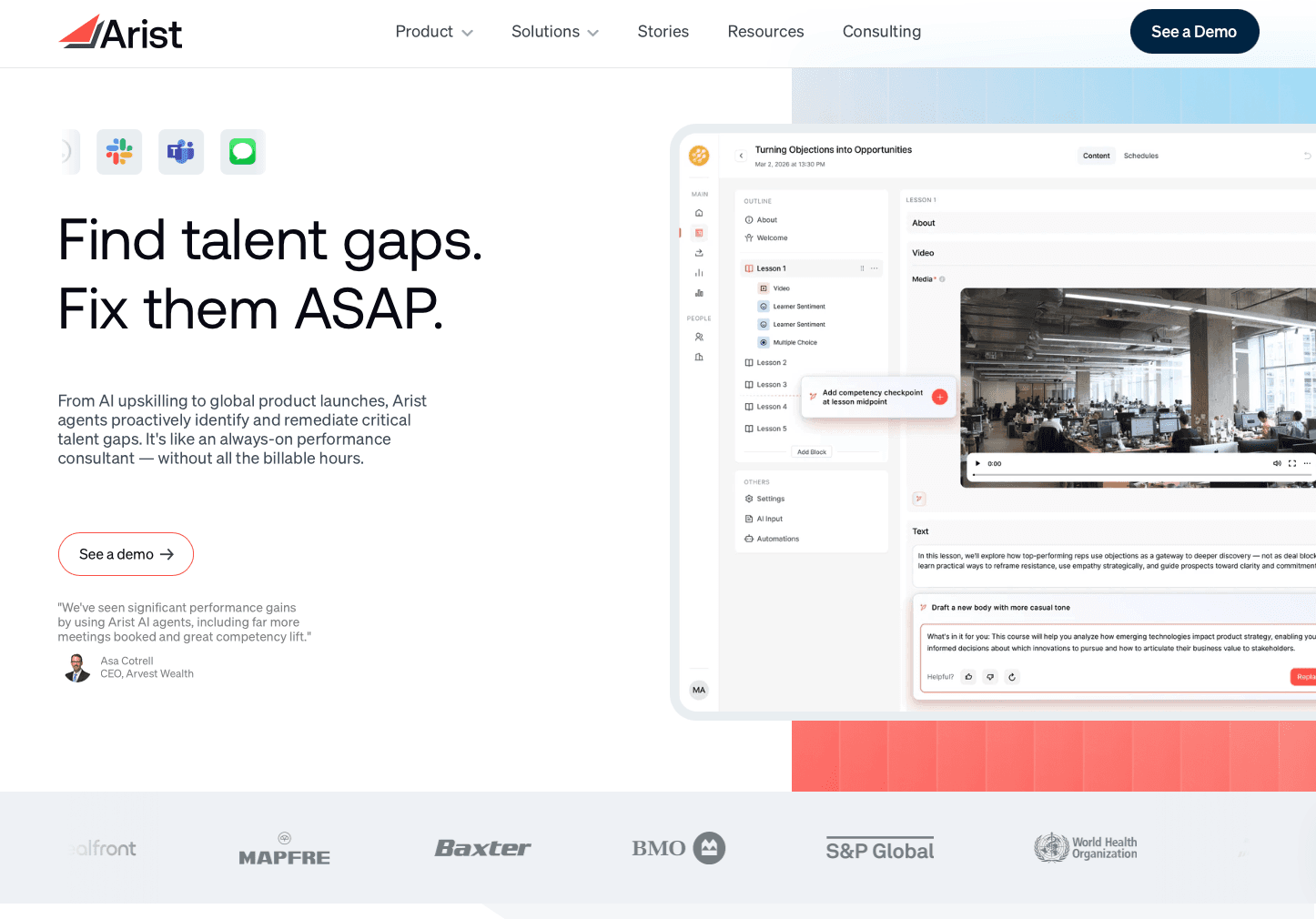
Traditional enterprise LMS tools solve the storage problem. Arist solves the performance problem.
Where an LMS hosts content and waits for employees to show up, Arist runs the full enablement flow: AI voice agents interview employees to surface gaps, a creator agent builds verified content personalized by role, and delivery happens directly in Teams, Slack, or SMS. No separate login. No context switch.
The results reflect it. Wolters Kluwer trained 30,000 people across 13 languages in three weeks, saving $1.62M. Novartis launched 140 programs with 70,000+ enrollments in six months, cutting what took six weeks down to four hours. Medtronic interviewed 100+ reps in under 48 hours and saw 3x adoption.
Legacy stacks can cost large enterprises millions annually across multiple disconnected tools. Arist replaces them with one end-to-end system that ties enablement directly to business outcomes. If your LMS can't tell you what changed in the business, it's not solving the right problem.
FAQs
How do you measure LMS ROI beyond completion rates?
Connect your learning data to business systems where performance actually gets recorded: time to productivity for new hires, sales attainment changes for trained cohorts, retention improvements, and compliance incident reduction after targeted training.
What security certifications should an enterprise LMS have?
Look for SOC 2 Type II (Type I alone isn't enough), ISO 27001, GDPR compliance for global workforces, multi-factor authentication with SSO support, role-based data access, encrypted data in transit and at rest, and timestamped audit trails for every user action.
How does in-the-flow-of-work delivery differ from traditional LMS approaches?
Training gets delivered directly in tools employees already use (Teams, Slack, SMS), eliminating the separate login and context switch that kills adoption in traditional LMS platforms.
Final Thoughts on Making Enterprise Learning Actually Stick
The enterprise learning management system you choose defines how far your training can actually go. If it only tracks completion, the result stays surface-level. More advanced approaches connect learning directly to performance and deliver it within the tools employees already use daily. Arist puts this into practice by embedding learning into everyday workflows, increasing the likelihood that training leads to real, measurable impact.
Your enterprise learning management system checked every box during procurement and passed every compliance review. Six months later, you’re still chasing completion reports and struggling to tie training spend to business results. The issue isn’t that the system failed. It’s doing exactly what it was built to do: host content. Adaptive, in-the-flow approaches change that by connecting learning directly to performance and delivering it where employees already work, closing the gap between activity and outcomes.
TLDR:
Enterprise LMS tools manage training for 10,000+ employees across regions and departments.
Most systems see 8% completion rates and -40 NPS because employees avoid separate logins.
Compliance tracking, HRIS integration, and audit trails are non-negotiable for industries facing strict regulatory requirements.
In-the-flow delivery via Teams, Slack, or SMS drives higher adoption than traditional platforms.
Some systems use AI agents to automate needs analysis through analytics, potentially cutting deployment from months to hours.
What Is an Enterprise Learning Management System?
An enterprise learning management system is software built to manage, deliver, and track employee training across a large organization. Where a basic LMS might serve a few hundred users in a single location, an enterprise LMS has to work for tens of thousands of people spread across departments, geographies, and time zones.
A few things set enterprise systems apart:
Role-based access controls that let different admins manage their own teams without touching others
Single sign-on (SSO) and integration with HRIS and HCM systems like Workday or SAP
Compliance reporting at scale, often across multiple regulatory frameworks
Localization and language support for global workforces
Audit trails and certification tracking that hold up to legal scrutiny
Core Features of Enterprise Learning Management Systems
The LMS market hit $30.51 billion in 2026 and is projected to reach $54.86 billion by 2031, growing at a 12.45% CAGR. What actually matters is whether the system handles the specific day-to-day weight of a large organization.
Scalability and Multi-Tenant Architecture: Enterprise organizations need a system that performs consistently at large concurrent user volumes without degradation. Multi-tenant architecture keeps departments and business units separated without requiring separate deployments.
HRIS and HCM Integration: Direct integration with Workday, SAP SuccessFactors, or PeopleSoft is non-negotiable. Without it, user provisioning, role assignments, and compliance data all require manual work that breaks down at scale.
Compliance and Audit Reporting: Industries facing strict compliance requirements need more than completion dashboards. They need timestamped audit trails, certification expiration tracking, and documentation that satisfies both internal audits and external regulators across multiple frameworks simultaneously.
Localization and Language Support: A workforce spanning 20 countries cannot run on English-only content. Enterprise LMS tools need to support content translation, locale-specific settings, and time zone logic for scheduling.
Advanced Analytics: Completion rates tell you what happened. Good analytics tell you why, and what to do next. Role-level reporting, cohort comparisons, and data exports into BI tools like Power BI are what separate informative reporting from actionable insight.
Types of Enterprise LMS Deployment Models
Three deployment models dominate enterprise LMS decisions: cloud-based, on-premise, and hybrid. Each comes with real trade-offs, and the right choice depends on your organization's tolerance for IT overhead, security requirements, and how fast you need to move.
Cloud-Based LMS: Cloud deployment is the default for most new enterprise implementations. The vendor manages infrastructure, handles updates, and scales with your user base without requiring internal IT resources. Over 72% of organizations are adopting cloud-based LMS solutions to improve training reach and learner engagement.
On-Premise LMS: On-premise deployment puts the system entirely behind your own firewall. Government agencies, defense contractors, and industries with strict compliance requirements often go this route when data sovereignty is non-negotiable. The tradeoff is steep: higher upfront infrastructure costs, dedicated IT support, and slower update cycles.
Hybrid LMS: Hybrid models split the difference. Core infrastructure stays on-premise while certain functions run in the cloud. This appeals to organizations mid-migration or those managing multiple regulatory environments.
Deployment Model | Infrastructure | Updates | IT Overhead | Cost Profile | Best Fit |
|---|---|---|---|---|---|
Cloud-Based | Vendor-managed servers and infrastructure | Automatic, vendor-controlled release cycles | Low - no dedicated internal IT required | Subscription-based, scales with user count | Most new enterprise implementations; fast deployment |
On-Premise | Hosted entirely behind your own firewall | Manual, managed by internal IT team | High - requires dedicated staff and maintenance | High upfront infrastructure and licensing costs | Government, defense, and strict data sovereignty requirements |
Hybrid | Core on-premise, select functions in the cloud | Mixed - depends on which layer is updating | Moderate - split between vendor and internal teams | Variable; combines infrastructure and subscription costs | Organizations mid-migration or managing multiple regulatory environments |
Enterprise LMS Security and Compliance Requirements
Security isn't a feature you assess late in the process. For enterprise organizations, it's the threshold requirement that determines which vendors even make the shortlist. There are several non-negotiable capabilities to look for when vetting any enterprise LMS:
SOC 2 Type II certification (Type I alone isn't enough)
ISO 27001 certification for information security management
GDPR and regional data privacy compliance, especially for global workforces
Multi-factor authentication and SSO support
Role-based data access with granular permission controls
Encrypted data in transit and at rest
Audit trails with timestamped logs for every user action. Modern corporate training solutions make this a baseline requirement.
The Challenge of Low Engagement in Traditional Enterprise LMS
Nearly every large enterprise has an LMS. 90% of organizations report using one, with usage reaching 100% among the largest firms. So the access problem is largely solved.
Average LMS completion rates sit at 8%. Average LMS NPS is -40. These are industry norms, not outliers.
The reason is structural. When learning lives in a separate system that employees have to seek out, most won't. A separate login, a different interface, a context switch away from actual work. Each small friction compounds into a habit of avoidance. Enterprises end up paying for systems that technically work while producing almost no behavior change.
Best Practices for Enterprise LMS Implementation
Most enterprise LMS implementations fail before the first course launches. The system goes live, adoption stalls, and the project gets blamed on the vendor when the real issue was how the rollout was planned.
A few practices consistently separate successful deployments from expensive shelf-ware:
Start with one department or use case, prove adoption, then expand. Trying to roll out company-wide on day one creates too many variables to troubleshoot. Starting with effective employee training methods in one department proves value faster.
Map your HRIS integration before procurement. User provisioning issues surfaced post-contract are painful and slow.
Involve frontline employees in testing alongside IT and L&D. They catch friction points that admins never see.
Define success metrics before launch. Completion rate alone is not a success metric worth optimizing for.
Build a communication plan alongside your content plan. People skip systems they don't understand or trust.
Change management is where most implementations quietly collapse. A technically functional LMS with no adoption strategy produces the same outcome as no LMS at all. Getting stakeholder alignment early, especially from managers who influence whether employees actually use the system, determines more of your outcome than any feature set. This is part of building a learning culture that sticks.
Measuring ROI and Impact of Enterprise Learning Systems
ROI conversations in L&D tend to collapse into completion rate reports that nobody outside the learning team finds compelling. Executives want to know what changed in the business, not how many employees clicked through a module.
Time to productivity for new hires or role transitions
Performance outcome changes tied to training cohorts (sales attainment, error rates, adoption of new tools)
Retention improvements linked to learning investment
Compliance incident reduction after targeted training
Kirkpatrick's four levels still hold up as a framework. Most organizations measure Level 1 (reaction) and Level 2 (learning) because they're easy to capture. Levels 3 and 4, behavior change and business results, require connecting your LMS data to CRM, HRIS, or performance systems.
If your learning data lives in a silo, you cannot prove impact. Tying enablement outcomes back to business metrics requires integration with the systems where performance actually gets recorded.
Enterprise LMS for Compliance Training at Scale
Compliance training is where LMS failures carry the highest cost. A missed certification renewal or incomplete audit trail can mean regulatory fines, legal exposure, or failed inspections. At enterprise scale, tracking expiration dates manually across thousands of employees is simply not feasible.
The core capabilities that make compliance manageable at scale:
Automated re-enrollment triggered by certification expiration dates, so nothing slips through without manual oversight
Role-based course assignment tied directly to HRIS job codes, so the right training reaches the right people automatically
Real-time dashboards showing completion status by department or region, giving managers visibility without chasing reports
Exportable audit reports formatted to specific regulatory standards, beyond generic spreadsheet exports
Industries like life sciences, financial services, and healthcare face particularly high stakes. A pharma company running MLR-reviewed training needs documentation trails that survive external audits. Financial services organizations need retention policies aligned with SEC or FINRA timelines.
What separates a compliance-ready LMS from a general one is how it handles exceptions. Who gets notified when someone misses a deadline? What triggers escalation? Can you pull a complete training history for a specific employee going back three years? Those edge cases surface constantly in audits, and the answer matters more than your overall completion rate.
The Shift to In-the-Flow-of-Work Learning
In-the-flow-of-work learning flips this. Training comes to employees through tools they already use: Teams, Slack, SMS. No separate login. No context switch. The average LMS sits at 8% completion, while content delivered in messaging tools can reach much higher rates because the friction is gone.
How Arist Changes Enterprise Enablement Beyond Traditional LMS
Traditional enterprise LMS tools solve the storage problem. Arist solves the performance problem.
Where an LMS hosts content and waits for employees to show up, Arist runs the full enablement flow: AI voice agents interview employees to surface gaps, a creator agent builds verified content personalized by role, and delivery happens directly in Teams, Slack, or SMS. No separate login. No context switch.
The results reflect it. Wolters Kluwer trained 30,000 people across 13 languages in three weeks, saving $1.62M. Novartis launched 140 programs with 70,000+ enrollments in six months, cutting what took six weeks down to four hours. Medtronic interviewed 100+ reps in under 48 hours and saw 3x adoption.
Legacy stacks can cost large enterprises millions annually across multiple disconnected tools. Arist replaces them with one end-to-end system that ties enablement directly to business outcomes. If your LMS can't tell you what changed in the business, it's not solving the right problem.
FAQs
How do you measure LMS ROI beyond completion rates?
Connect your learning data to business systems where performance actually gets recorded: time to productivity for new hires, sales attainment changes for trained cohorts, retention improvements, and compliance incident reduction after targeted training.
What security certifications should an enterprise LMS have?
Look for SOC 2 Type II (Type I alone isn't enough), ISO 27001, GDPR compliance for global workforces, multi-factor authentication with SSO support, role-based data access, encrypted data in transit and at rest, and timestamped audit trails for every user action.
How does in-the-flow-of-work delivery differ from traditional LMS approaches?
Training gets delivered directly in tools employees already use (Teams, Slack, SMS), eliminating the separate login and context switch that kills adoption in traditional LMS platforms.
Final Thoughts on Making Enterprise Learning Actually Stick
The enterprise learning management system you choose defines how far your training can actually go. If it only tracks completion, the result stays surface-level. More advanced approaches connect learning directly to performance and deliver it within the tools employees already use daily. Arist puts this into practice by embedding learning into everyday workflows, increasing the likelihood that training leads to real, measurable impact.
Related Resources

Article
AI Upskilling: A Practical Guide for Building Your Team in June 2026
Learn how to build AI upskilling programs that drive behavior change. Practical guide with frameworks, metrics, and proven strategies for June 2026.
Read more
Article
Salesforce Training for Beginners: Complete June 2026 Guide
Complete Salesforce training for beginners in June 2026. Learn Trailhead, certifications, admin paths, and career options with this full overview.
Read more
Bring real impact to your people
We care about solving meaningful problems and being thought partners first and foremost. Arist is used and loved by the Fortune 500 — and we'd love to support your goals.
Curious to get a demo or free trial? We'd love to chat:

Bring real impact to your people
We care about solving meaningful problems and being thought partners first and foremost. Arist is used and loved by the Fortune 500 — and we'd love to support your goals.
Curious to get a demo or free trial? We'd love to chat:
Bring real impact to your people
We care about solving meaningful problems and being thought partners first and foremost. Arist is used and loved by the Fortune 500 — and we'd love to support your goals.
Curious to get a demo or free trial? We'd love to chat: