Personalized Learning Platforms: Benefits, Features, and Top Picks for March 2026
Personalized Learning Platforms: Benefits, Features, and Top Picks for March 2026
Compare personalized learning platforms in March 2026. Benefits, features, and top picks including AI-powered solutions for employee training and development.
Most enterprises deploy a personalized learning platform expecting higher engagement, then watch completion rates drop to 30% because logging into another system feels like homework. Some of the most effective platforms skip the portal entirely and push content through Teams, Slack, or text messages where employees already work. We tested six AI-powered personalized learning platforms on whether they can identify skill gaps before creating content, adapt training to each role's real needs, and measure what actually changes in your business instead of just counting who finished the course.
TLDR:
Personalized learning adapts training to each employee's role and skill gaps using AI.
Some AI-powered platforms automate the full cycle: interviews find gaps, create content, deliver via Teams/Slack/SMS.
Traditional LMS completion rates hit 20-30%; in-the-flow delivery achieves 95%+ engagement.
Wolters Kluwer drove 120% more AI usage across 30,000 people in 3 weeks using personalized learning.
Certain end-to-end platforms handle needs analysis, creation, delivery, and analytics through Teams, Slack, and SMS.
What Are Personalized Learning Solutions?
Personalized learning solutions adapt training content to each employee's needs, role, and skill level using AI and data analytics. These systems analyze individual learner data (past performance, role requirements, skill gaps, learning pace) and adjust what people learn, when they learn it, and how it's delivered.
Traditional corporate learning pushes identical content to every employee. A new sales rep gets the same product training as a 10-year veteran. An engineer in Tokyo sees the same compliance module as a manager in Chicago. This creates disengagement and poor retention.
Personalized learning flips that model. Someone who already understands the basics can skip ahead. Someone struggling with a concept gets reinforcement. A field rep might receive training via text message, while an office worker gets it in Teams. The result: higher completion rates, faster time-to-competency, and real performance lift.
How We Ranked Personalized Learning Solutions
We tested these solutions on criteria that matter in real deployments, not marketing copy. Here's what we looked at.
First, workflow coverage. Some tools only deliver content. Others also build it, identify skill gaps, and measure results. We noted which functions each one covers.
Second, delivery method. Does it reach learners in Slack, Teams, or SMS, or does it require a separate login? This gap often separates 90% completion rates from 30%.
Third, AI capability. Can it generate role-specific content from your own files, or does it just tweak generic courses? AI adoption in enterprises continues accelerating, but real personalization adapts to each role's actual work.
Fourth, time to launch. Can you deploy training in days, or does setup take months? Speed matters when product launches or compliance deadlines hit.
Fifth, enterprise readiness. We checked for SSO, HRIS integrations, compliance features, and multi-language support. If it can't meet regulatory standards or plug into your systems, it won't work at scale.
Platform | Needs Analysis | Content Creation | Delivery Channels | Primary Use Case | Typical Engagement |
|---|---|---|---|---|---|
Arist | AI voice agents conduct employee interviews and gap analysis | AI generates role-specific content from your files in hours | Teams, Slack, SMS push delivery | Enterprise-wide enablement across HR, IT, Sales | 95%+ completion rates |
Letter AI | No automated needs analysis | AI builds FAQs and battle cards in minutes | Portal login required | Revenue and sales enablement | Not disclosed |
Degreed | Skills taxonomy and career mapping | Content aggregation from existing libraries | Portal login required | Skills development and career pathing | 20-30% self-directed engagement |
Docebo | Manual assignment workflows | Course management with third-party integrations | Portal-first LMS with virtual classroom connectors | Compliance training and structured courses | Engagement depends on adoption and usage patterns |
Skillsoft | No gap identification | Pre-built content library across business topics | Integrates with existing LMS | Off-the-shelf compliance and professional development | Depends on LMS delivery |
Sana Labs | Knowledge retrieval, not learning diagnosis | Q&A and semantic search across documentation | Conversational query interface | Knowledge retrieval and search | Search-based interaction |
Arist
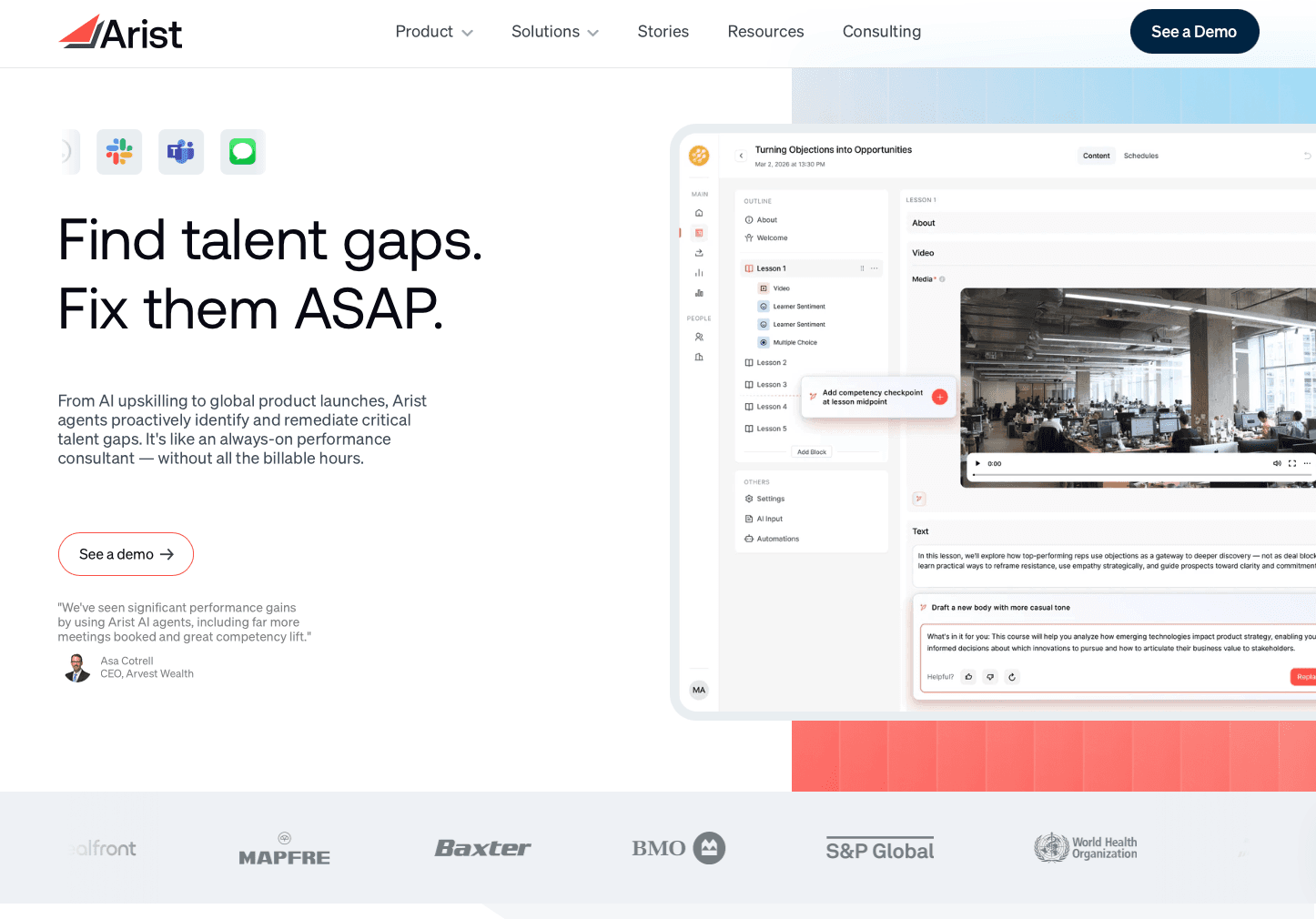
We built Arist to fix what's broken in enterprise enablement. Our AI agents handle the full workflow: interviewing employees to find gaps, creating personalized content from your files, delivering it where people actually work, and measuring what matters.
Voice agents conduct hundreds of employee interviews simultaneously, analyze internal data, and build gap reports in days instead of the longer timelines typical of legacy training software. AI-powered content creation turns source documents into role-specific courses, translated into 40+ languages with built-in assessments. Delivery through Teams, Slack, and SMS achieves 95%+ engagement versus 20-30% on legacy systems requiring separate logins. Real-time analytics tie learning data back to business outcomes and recommend next interventions.
Wolters Kluwer used Arist to drive 120% more AI usage across 30,000 people in 3 weeks while saving $1.62M. That's what happens when you stop forcing employees into another portal and start meeting them where they work.
Letter AI
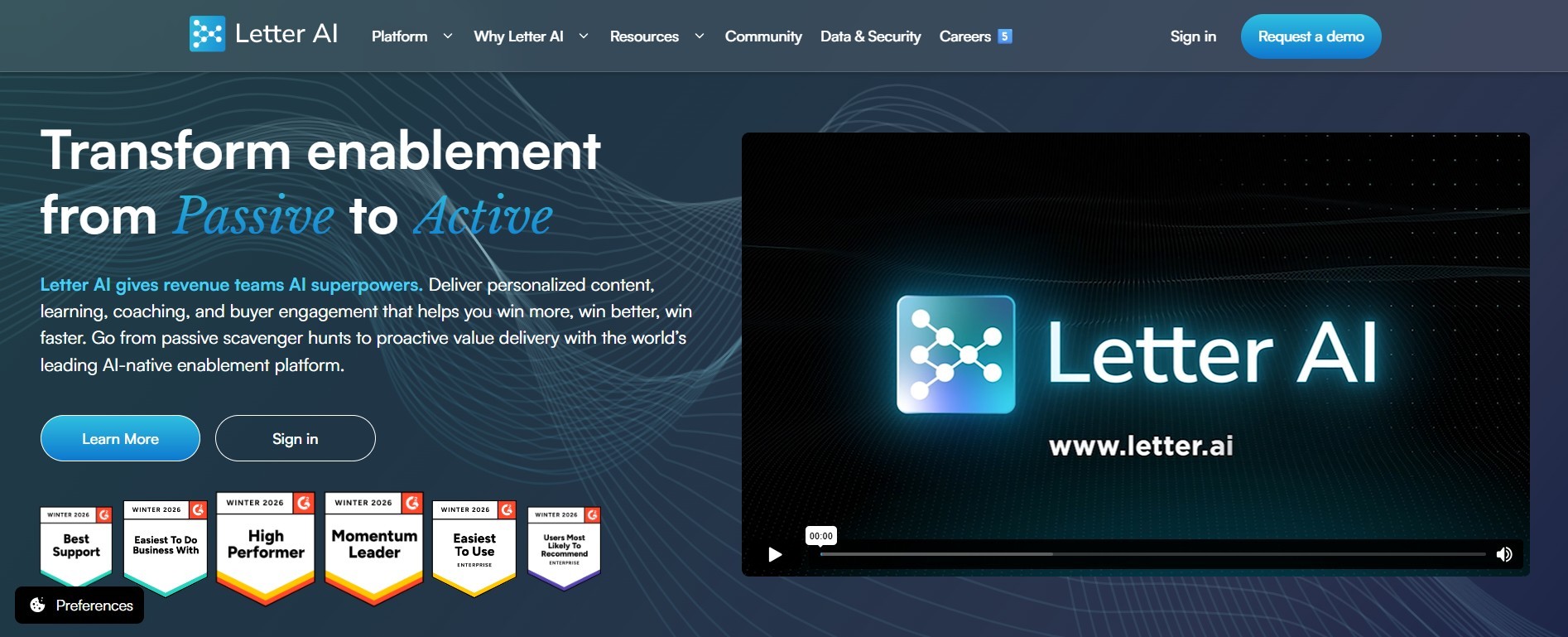
Letter AI is a unified revenue enablement tool that combines content management and learning management with AI workflows to create training and content in minutes.
Letter AI delivers AI-powered training and coaching with interactive learning paths and certification programs. The content creation engine uses AI to build FAQs and battle cards, reducing build time by 90%. Voice, chat, and email roleplay features let reps practice skills indexed on company knowledge.
Good for sales teams at B2B organizations that need rapid revenue enablement content creation and want an all-in-one CMS and LMS.
Limitation: Letter AI focuses primarily on revenue and sales enablement use cases instead of enterprise-wide people enablement across HR, IT, and Sales. It lacks end-to-end needs analysis capabilities and in-the-flow-of-work delivery via SMS and messaging that drive lasting behavior change for frontline and distributed workforces.
Degreed
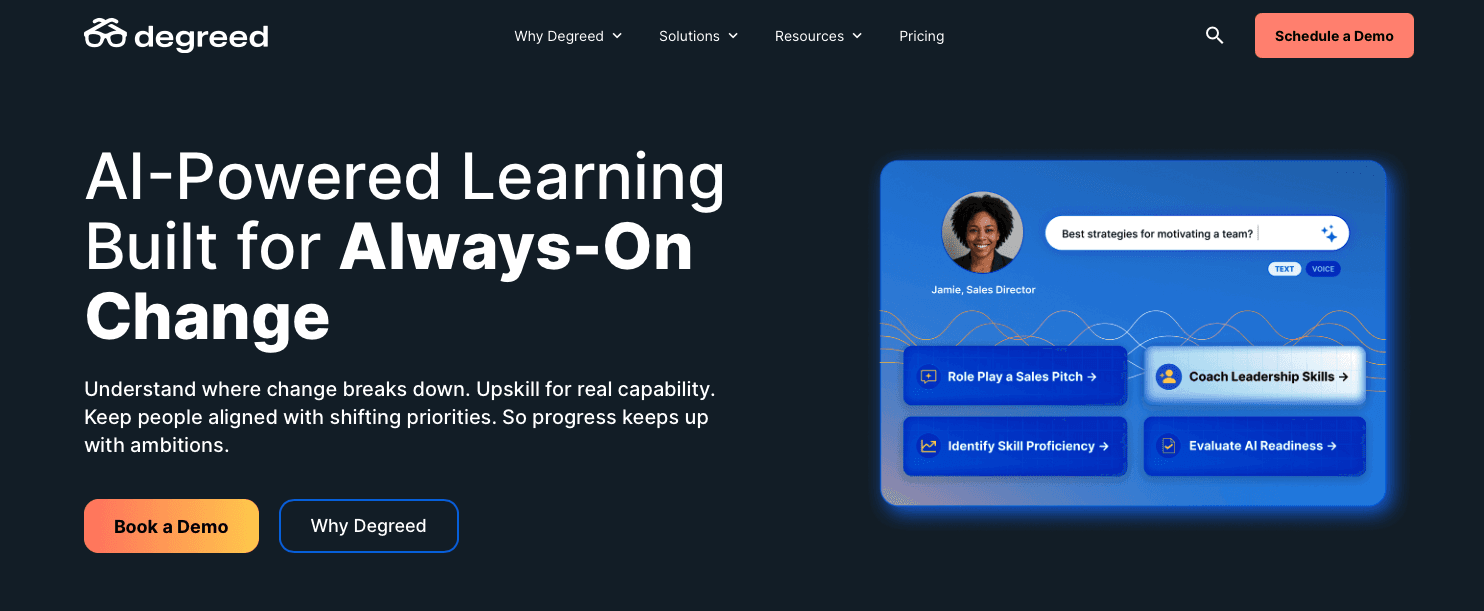
Degreed is a learning experience tool focused on content aggregation, skills frameworks, and career-pathing for enterprise learners.
Degreed pulls together content from multiple sources into one catalog. Skills-based learning pathways help employees map career development. Integration with existing content libraries creates a unified view. Social learning features support peer recommendations.
Good for organizations with extensive content libraries who want skills taxonomy and career development tools layered on top of existing materials.
Limitation: Degreed requires portal login and aggregates content instead of creating it. No delivery via SMS or messaging apps. It relies on self-directed discovery, which drives the 20-30% engagement rates typical of systems that depend on employees remembering to check another portal.
Docebo
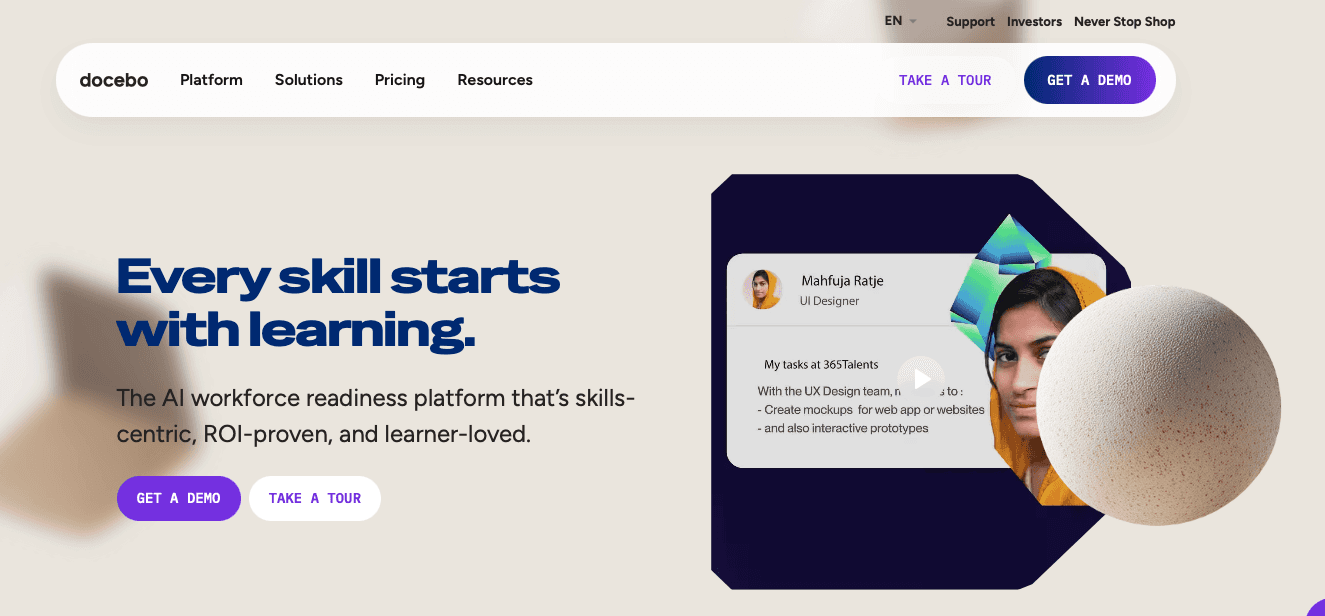
Docebo is an AI-powered learning tool designed for mid-sized to large organizations, supporting employees, partners, and customers from a single system for use cases like onboarding, enablement, and compliance.
Cloud-based LMS with course management and learning path creation. AI features personalize learning experiences and automate routine tasks like assignments and enrollments. Extensive third-party integrations and virtual classroom connectors. Social learning capabilities with discussion forums and gamification elements.
Good for mid-to-large enterprises that need a traditional LMS for structured compliance training and course management with strong reporting capabilities.
Limitation: Docebo is a portal-first LMS that requires learners to log in to access content, which can be difficult for frontline workers to adopt and results in low engagement rates. It lacks proactive needs analysis, does not focus on SMS or push-first messaging delivery, and does not manage the end-to-end enablement flow from gap identification through proven impact.
Skillsoft
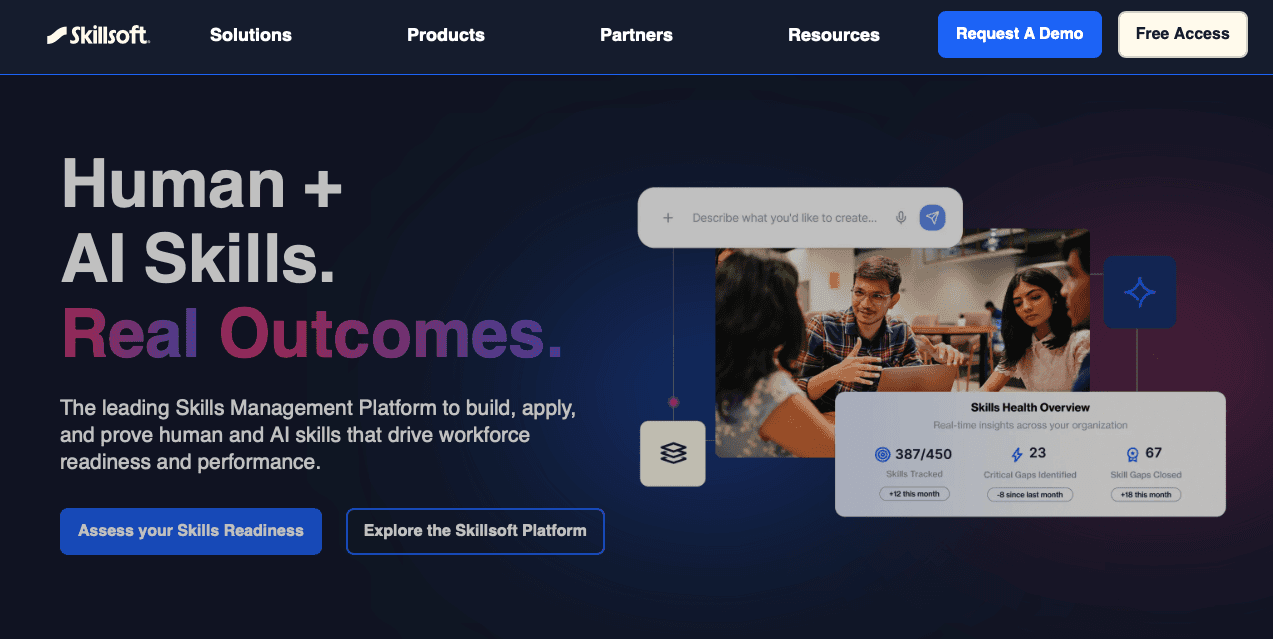
Skillsoft is a content library offering pre-built courses, certifications, and professional development materials across business topics. They provide compliance, leadership, and technical training that integrate with existing LMS systems.
Good for teams that need ready-made content libraries without building materials from scratch.
Limitation: Skillsoft is a content repository, not a complete learning system. It lacks AI-powered content creation for your specific needs, provides no skills gap identification, requires separate delivery systems, and doesn't deliver learning in the flow of work through messaging channels.
Sana Labs
Sana Labs builds AI search and knowledge retrieval for enterprises. Teams query organizational content through Q&A interfaces and semantic search across documentation. It supports multiple languages and connects to existing knowledge bases.
Good for teams whose priority is helping employees find stored information through conversational queries instead of delivering structured learning content.
Limitation: Sana Labs retrieves knowledge but doesn't manage learning over time. You won't find automated reinforcement, spaced repetition, or push delivery to SMS and messaging apps without custom development work.
Why Arist Is the Best Personalized Learning Solution
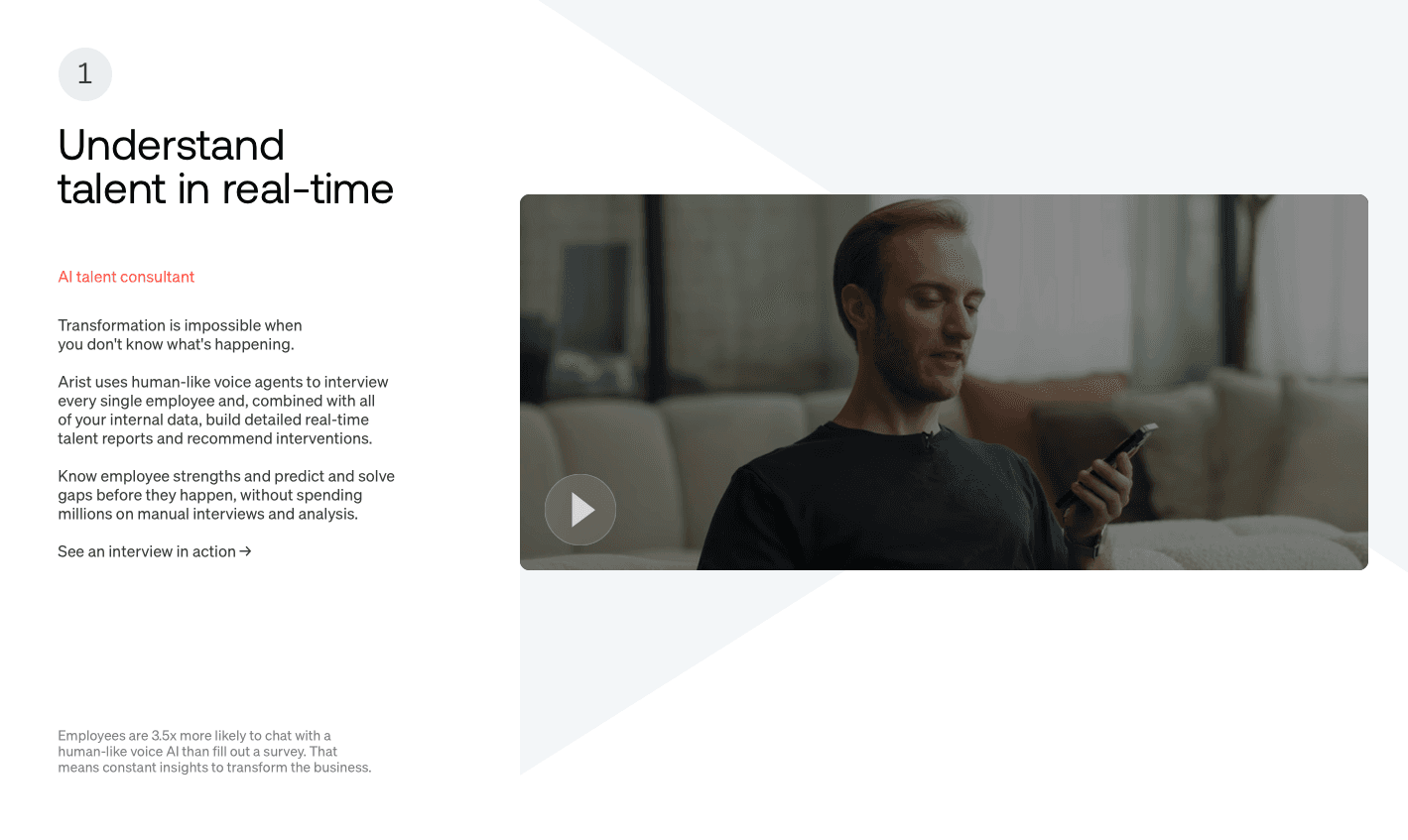
Arist automates the full cycle from diagnosis to delivery. AI voice agents interview employees to surface skill gaps. Creator agents build personalized content from your files in hours. Delivery happens in Teams, Slack, and SMS where people already work. Analytics tie learning back to business outcomes and recommend what to fix next.
Wolters Kluwer drove 120% more AI usage across 30,000 people in three weeks using Arist. Novartis launched 140 programs with 70,000 enrollments in six months, saving $2.2M annually. That's what happens when you stop treating learning like a separate task and build it into the workflow.
Many enterprises run enablement through multiple disconnected platforms that cost millions and take months to deploy. Arist replaces that stack with one system that launches in days. No more paying for content libraries nobody opens, survey tools with 20% response rates, or LMS portals where completion stalls at 30%. Arist handles needs analysis, content creation, delivery, and analytics while your team focuses on strategy instead of managing vendors. Learning in the flow of work is the new standard for enterprise enablement.
FAQs
Which personalized learning tools work best for frontline workers?
Frontline workers rarely log into portals consistently. You need delivery through SMS or messaging apps they already use. Arist delivers training via text message with 95%+ completion rates because it meets people where they are. Portal-based systems like Degreed and Docebo typically see 20-30% engagement with frontline teams.
Can AI actually create training content from my company's files?
Yes, but quality varies. AI content creation should turn your source documents into role-specific courses with built-in assessments and translations. Arist's Creator Agent builds personalized training from uploaded files in hours instead of months. Letter AI also offers AI content creation focused on sales enablement use cases. Generic course libraries often don't reflect your actual business needs.
What's the difference between content libraries and AI-powered learning systems?
Content libraries like Skillsoft provide pre-built courses you can browse. AI-powered systems like Arist create custom training from your materials, personalize it by role, and deliver it when and where each employee needs it. One gives you a catalog to search. The other builds what you actually need and pushes it to your team.
Final Thoughts on AI-Powered Learning
Choosing the right personalized learning platform comes down to whether you want another content library or a system that drives real results. Most platforms add complexity without solving the core problem: employees won't log into another portal. The best personalized learning platforms meet people where they work and automate the full enablement cycle from gap identification through delivery to impact measurement. Arist handles the full workflow from interviewing employees to delivering personalized training in SMS, Teams, and Slack where engagement hits 95%. Your team doesn't need another portal to remember. They need training that fits into how work actually gets done, with analytics that tie learning back to business outcomes.
Most enterprises deploy a personalized learning platform expecting higher engagement, then watch completion rates drop to 30% because logging into another system feels like homework. Some of the most effective platforms skip the portal entirely and push content through Teams, Slack, or text messages where employees already work. We tested six AI-powered personalized learning platforms on whether they can identify skill gaps before creating content, adapt training to each role's real needs, and measure what actually changes in your business instead of just counting who finished the course.
TLDR:
Personalized learning adapts training to each employee's role and skill gaps using AI.
Some AI-powered platforms automate the full cycle: interviews find gaps, create content, deliver via Teams/Slack/SMS.
Traditional LMS completion rates hit 20-30%; in-the-flow delivery achieves 95%+ engagement.
Wolters Kluwer drove 120% more AI usage across 30,000 people in 3 weeks using personalized learning.
Certain end-to-end platforms handle needs analysis, creation, delivery, and analytics through Teams, Slack, and SMS.
What Are Personalized Learning Solutions?
Personalized learning solutions adapt training content to each employee's needs, role, and skill level using AI and data analytics. These systems analyze individual learner data (past performance, role requirements, skill gaps, learning pace) and adjust what people learn, when they learn it, and how it's delivered.
Traditional corporate learning pushes identical content to every employee. A new sales rep gets the same product training as a 10-year veteran. An engineer in Tokyo sees the same compliance module as a manager in Chicago. This creates disengagement and poor retention.
Personalized learning flips that model. Someone who already understands the basics can skip ahead. Someone struggling with a concept gets reinforcement. A field rep might receive training via text message, while an office worker gets it in Teams. The result: higher completion rates, faster time-to-competency, and real performance lift.
How We Ranked Personalized Learning Solutions
We tested these solutions on criteria that matter in real deployments, not marketing copy. Here's what we looked at.
First, workflow coverage. Some tools only deliver content. Others also build it, identify skill gaps, and measure results. We noted which functions each one covers.
Second, delivery method. Does it reach learners in Slack, Teams, or SMS, or does it require a separate login? This gap often separates 90% completion rates from 30%.
Third, AI capability. Can it generate role-specific content from your own files, or does it just tweak generic courses? AI adoption in enterprises continues accelerating, but real personalization adapts to each role's actual work.
Fourth, time to launch. Can you deploy training in days, or does setup take months? Speed matters when product launches or compliance deadlines hit.
Fifth, enterprise readiness. We checked for SSO, HRIS integrations, compliance features, and multi-language support. If it can't meet regulatory standards or plug into your systems, it won't work at scale.
Platform | Needs Analysis | Content Creation | Delivery Channels | Primary Use Case | Typical Engagement |
|---|---|---|---|---|---|
Arist | AI voice agents conduct employee interviews and gap analysis | AI generates role-specific content from your files in hours | Teams, Slack, SMS push delivery | Enterprise-wide enablement across HR, IT, Sales | 95%+ completion rates |
Letter AI | No automated needs analysis | AI builds FAQs and battle cards in minutes | Portal login required | Revenue and sales enablement | Not disclosed |
Degreed | Skills taxonomy and career mapping | Content aggregation from existing libraries | Portal login required | Skills development and career pathing | 20-30% self-directed engagement |
Docebo | Manual assignment workflows | Course management with third-party integrations | Portal-first LMS with virtual classroom connectors | Compliance training and structured courses | Engagement depends on adoption and usage patterns |
Skillsoft | No gap identification | Pre-built content library across business topics | Integrates with existing LMS | Off-the-shelf compliance and professional development | Depends on LMS delivery |
Sana Labs | Knowledge retrieval, not learning diagnosis | Q&A and semantic search across documentation | Conversational query interface | Knowledge retrieval and search | Search-based interaction |
Arist
We built Arist to fix what's broken in enterprise enablement. Our AI agents handle the full workflow: interviewing employees to find gaps, creating personalized content from your files, delivering it where people actually work, and measuring what matters.
Voice agents conduct hundreds of employee interviews simultaneously, analyze internal data, and build gap reports in days instead of the longer timelines typical of legacy training software. AI-powered content creation turns source documents into role-specific courses, translated into 40+ languages with built-in assessments. Delivery through Teams, Slack, and SMS achieves 95%+ engagement versus 20-30% on legacy systems requiring separate logins. Real-time analytics tie learning data back to business outcomes and recommend next interventions.
Wolters Kluwer used Arist to drive 120% more AI usage across 30,000 people in 3 weeks while saving $1.62M. That's what happens when you stop forcing employees into another portal and start meeting them where they work.
Letter AI
Letter AI is a unified revenue enablement tool that combines content management and learning management with AI workflows to create training and content in minutes.
Letter AI delivers AI-powered training and coaching with interactive learning paths and certification programs. The content creation engine uses AI to build FAQs and battle cards, reducing build time by 90%. Voice, chat, and email roleplay features let reps practice skills indexed on company knowledge.
Good for sales teams at B2B organizations that need rapid revenue enablement content creation and want an all-in-one CMS and LMS.
Limitation: Letter AI focuses primarily on revenue and sales enablement use cases instead of enterprise-wide people enablement across HR, IT, and Sales. It lacks end-to-end needs analysis capabilities and in-the-flow-of-work delivery via SMS and messaging that drive lasting behavior change for frontline and distributed workforces.
Degreed
Degreed is a learning experience tool focused on content aggregation, skills frameworks, and career-pathing for enterprise learners.
Degreed pulls together content from multiple sources into one catalog. Skills-based learning pathways help employees map career development. Integration with existing content libraries creates a unified view. Social learning features support peer recommendations.
Good for organizations with extensive content libraries who want skills taxonomy and career development tools layered on top of existing materials.
Limitation: Degreed requires portal login and aggregates content instead of creating it. No delivery via SMS or messaging apps. It relies on self-directed discovery, which drives the 20-30% engagement rates typical of systems that depend on employees remembering to check another portal.
Docebo
Docebo is an AI-powered learning tool designed for mid-sized to large organizations, supporting employees, partners, and customers from a single system for use cases like onboarding, enablement, and compliance.
Cloud-based LMS with course management and learning path creation. AI features personalize learning experiences and automate routine tasks like assignments and enrollments. Extensive third-party integrations and virtual classroom connectors. Social learning capabilities with discussion forums and gamification elements.
Good for mid-to-large enterprises that need a traditional LMS for structured compliance training and course management with strong reporting capabilities.
Limitation: Docebo is a portal-first LMS that requires learners to log in to access content, which can be difficult for frontline workers to adopt and results in low engagement rates. It lacks proactive needs analysis, does not focus on SMS or push-first messaging delivery, and does not manage the end-to-end enablement flow from gap identification through proven impact.
Skillsoft
Skillsoft is a content library offering pre-built courses, certifications, and professional development materials across business topics. They provide compliance, leadership, and technical training that integrate with existing LMS systems.
Good for teams that need ready-made content libraries without building materials from scratch.
Limitation: Skillsoft is a content repository, not a complete learning system. It lacks AI-powered content creation for your specific needs, provides no skills gap identification, requires separate delivery systems, and doesn't deliver learning in the flow of work through messaging channels.
Sana Labs
Sana Labs builds AI search and knowledge retrieval for enterprises. Teams query organizational content through Q&A interfaces and semantic search across documentation. It supports multiple languages and connects to existing knowledge bases.
Good for teams whose priority is helping employees find stored information through conversational queries instead of delivering structured learning content.
Limitation: Sana Labs retrieves knowledge but doesn't manage learning over time. You won't find automated reinforcement, spaced repetition, or push delivery to SMS and messaging apps without custom development work.
Why Arist Is the Best Personalized Learning Solution
Arist automates the full cycle from diagnosis to delivery. AI voice agents interview employees to surface skill gaps. Creator agents build personalized content from your files in hours. Delivery happens in Teams, Slack, and SMS where people already work. Analytics tie learning back to business outcomes and recommend what to fix next.
Wolters Kluwer drove 120% more AI usage across 30,000 people in three weeks using Arist. Novartis launched 140 programs with 70,000 enrollments in six months, saving $2.2M annually. That's what happens when you stop treating learning like a separate task and build it into the workflow.
Many enterprises run enablement through multiple disconnected platforms that cost millions and take months to deploy. Arist replaces that stack with one system that launches in days. No more paying for content libraries nobody opens, survey tools with 20% response rates, or LMS portals where completion stalls at 30%. Arist handles needs analysis, content creation, delivery, and analytics while your team focuses on strategy instead of managing vendors. Learning in the flow of work is the new standard for enterprise enablement.
FAQs
Which personalized learning tools work best for frontline workers?
Frontline workers rarely log into portals consistently. You need delivery through SMS or messaging apps they already use. Arist delivers training via text message with 95%+ completion rates because it meets people where they are. Portal-based systems like Degreed and Docebo typically see 20-30% engagement with frontline teams.
Can AI actually create training content from my company's files?
Yes, but quality varies. AI content creation should turn your source documents into role-specific courses with built-in assessments and translations. Arist's Creator Agent builds personalized training from uploaded files in hours instead of months. Letter AI also offers AI content creation focused on sales enablement use cases. Generic course libraries often don't reflect your actual business needs.
What's the difference between content libraries and AI-powered learning systems?
Content libraries like Skillsoft provide pre-built courses you can browse. AI-powered systems like Arist create custom training from your materials, personalize it by role, and deliver it when and where each employee needs it. One gives you a catalog to search. The other builds what you actually need and pushes it to your team.
Final Thoughts on AI-Powered Learning
Choosing the right personalized learning platform comes down to whether you want another content library or a system that drives real results. Most platforms add complexity without solving the core problem: employees won't log into another portal. The best personalized learning platforms meet people where they work and automate the full enablement cycle from gap identification through delivery to impact measurement. Arist handles the full workflow from interviewing employees to delivering personalized training in SMS, Teams, and Slack where engagement hits 95%. Your team doesn't need another portal to remember. They need training that fits into how work actually gets done, with analytics that tie learning back to business outcomes.
Related Resources

Article
AI Upskilling: A Practical Guide for Building Your Team in June 2026
Learn how to build AI upskilling programs that drive behavior change. Practical guide with frameworks, metrics, and proven strategies for June 2026.
Read more
Article
Salesforce Training for Beginners: Complete June 2026 Guide
Complete Salesforce training for beginners in June 2026. Learn Trailhead, certifications, admin paths, and career options with this full overview.
Read more
Bring real impact to your people
We care about solving meaningful problems and being thought partners first and foremost. Arist is used and loved by the Fortune 500 — and we'd love to support your goals.
Curious to get a demo or free trial? We'd love to chat:

Bring real impact to your people
We care about solving meaningful problems and being thought partners first and foremost. Arist is used and loved by the Fortune 500 — and we'd love to support your goals.
Curious to get a demo or free trial? We'd love to chat:
Bring real impact to your people
We care about solving meaningful problems and being thought partners first and foremost. Arist is used and loved by the Fortune 500 — and we'd love to support your goals.
Curious to get a demo or free trial? We'd love to chat: