Best Online Training Solutions for 2026: Features, Pricing & Benefits
Best Online Training Solutions for 2026: Features, Pricing & Benefits
Compare the best online training solutions for 2025. Learn about features, pricing, and AI-powered platforms that boost employee engagement and ROI.
Online training solutions have earned a bad reputation by pulling employees out of their workday, locking learning behind separate logins, and charging per seat whether anyone actually engages. Teams sit through long courses, forget most of the content, and leaders are left guessing if any of it moved revenue, safety, or productivity. In 2026, that model no longer holds. The tools gaining adoption now deliver learning inside Slack, Teams, and SMS, generate courses from existing documents in hours, and tie completion data to outcomes leaders already track. In this guide, we break down what’s changed, why legacy systems fall short, and how a modern training approach fits into the way work actually gets done today.
TLDR:
Online training solutions in 2026 must deliver learning inside tools teams already use daily to hit 95%+ completion rates.
AI-powered platforms now generate courses in hours instead of weeks, cutting content creation time by 90%.
Multi-channel delivery via SMS, Teams, and Slack reaches 80% of workers who are deskless without computer access.
The global skills gap could cost $5.5 trillion by 2026, making rapid training deployment a competitive advantage.
Some solutions automate the full training loop (needs analysis, content creation, delivery, and analytics), achieving 95% adoption rates.
What Makes an Effective Online Training Solution in February 2026
The bar for effective training has moved. Hosting content and tracking completions is no longer enough. Today's training needs to change behavior, reach employees where they work, and prove business impact.
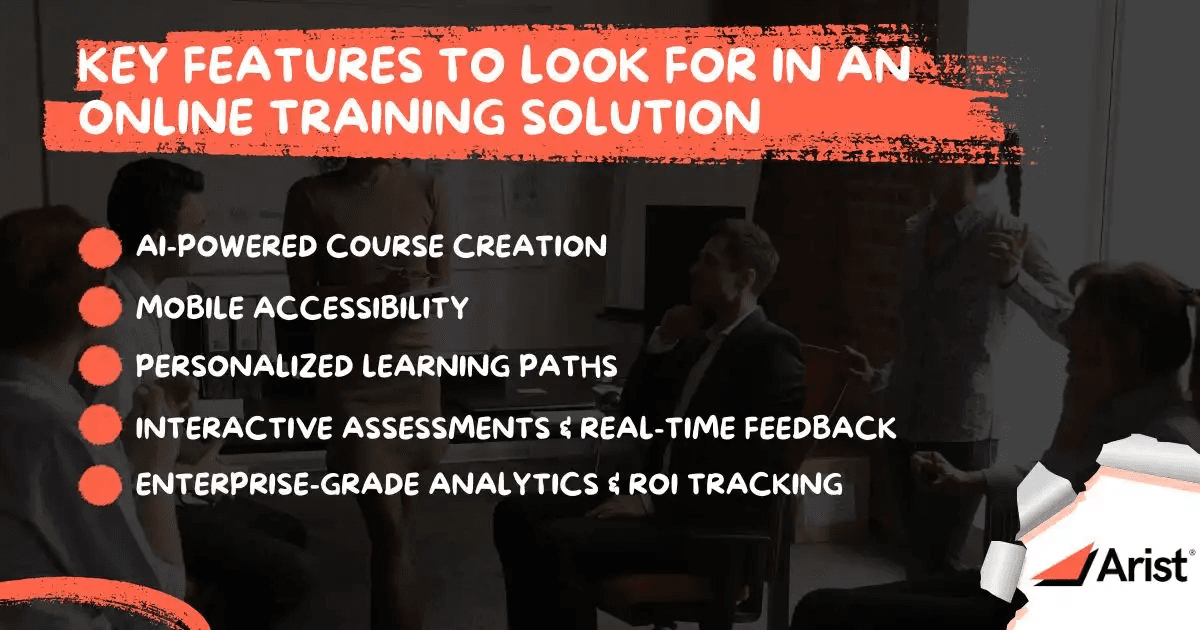
Look for solutions that deliver learning inside the tools your team already uses: messaging apps, SMS, or collaboration software. When training shows up in the flow of work instead of behind a separate login, completion rates jump to over 95%.
Speed matters too. The best solutions generate content in hours using AI to ingest your materials and create courses instantly.
Analytics should connect training to real outcomes. Can you see how learning impacts sales pipeline, safety incidents, or customer satisfaction?
AI Training Capabilities That Drive Real Business Results
AI now handles course generation from source material, conducts voice interviews to identify skill gaps, and builds personalized learning paths based on role and performance data.
This automation solves a critical problem: 38% of AI adoption challenges come from insufficient training in AI tools. The best solutions instantly translate content into 50+ languages, verify accuracy against source documents, and adapt reinforcement based on learner responses.
The impact shows in deployment speed. What consultants used to deliver in six weeks can now take four hours, with automated fact-checking maintaining accuracy while personalizing delivery across sales reps, medical science liaisons, and executives.
Flow of Work Training vs. Traditional LMS Approaches
Traditional LMS systems pull employees out of their workflow, requiring separate logins, portal navigation, and dedicated computer time. Many employees only check their LMS every few weeks.
Flow of work training delivers lessons directly inside messaging tools teams already use daily. A sales rep gets a lesson in Teams between calls. A warehouse worker receives safety updates via SMS during break. No app downloads, no password resets, no context switching.
This approach matters most for frontline and deskless workers without regular computer access. SMS and WhatsApp reach them on personal or company devices without requiring portal access during shifts.
The Growing Enterprise Skills Gap and What It Means for Training Investment
IDC research projects that 90 percent of global enterprises will face critical skills shortages by 2026, potentially costing the global economy $5.5 trillion through product delays and lost revenue.
Reactive training strategies can't close gaps fast enough. By the time you identify a need, hire consultants, build content, and roll it out through traditional channels, the business context has shifted. Product launches get delayed. Competitors move faster. Revenue opportunities slip away.
Training that deploys in days reaches your entire workforce through channels they already use daily. The cost of slow training now exceeds the investment in faster alternatives.
Multi-Channel Delivery: Reaching Desk and Deskless Workers
Roughly 80 percent of the global workforce is deskless. They work in warehouses, hospitals, retail stores, and manufacturing floors without regular access to computers or corporate portals. If your training only reaches desk workers, you're leaving most of your workforce untrained.
SMS and WhatsApp delivery solve this accessibility problem. Frontline employees receive lessons on their phones during breaks or between tasks. No computer required. No app downloads. No corporate network login.
When training can't reach your entire workforce, functional risks multiply. Safety protocols don't reach factory floors. Product knowledge stops at corporate headquarters. Compliance gaps widen across distributed teams.
Multi-channel delivery turns training into something every employee can access, regardless of where or how they work.
Training ROI: Connecting Learning to Business Outcomes
Completion rates show who finished, not what changed. Real ROI measurement connects training to business metrics: revenue per employee, time-to-productivity for new hires, safety incident reduction, and customer satisfaction scores.
94 percent of employees stay longer at companies that invest in their learning. That retention impact saves recruitment costs and preserves institutional knowledge.
Track time-to-competency reductions. If new sales reps close their first deal three weeks faster after training changes, multiply that by your average deal size and number of new hires.
Strong training analytics answer questions like "Which interventions improved manager performance last quarter?" When you can query outcomes in real-time, budget conversations shift from cost justification to growth investment.
Pricing Models for Corporate Training Solutions Explained
Per-user pricing charges monthly or annually for each active learner. This model scales linearly with headcount but can become expensive for large organizations or high-turnover roles where seats go unused.
Enterprise licensing offers flat-rate access for your entire organization regardless of size. This works well for companies over 5,000 employees where per-user math breaks down, but smaller organizations often overpay for capacity they won't use.
Cohort-based pricing charges per training group or campaign instead of individual seats. You pay for the initiative, not the headcount.
Watch for hidden costs that double your budget. Implementation fees can run $50k-$200k for complex integrations. Custom development often requires dedicated IT resources.
Calculate total cost of ownership across three years.
Pricing Model | How It Works | Best For | Key Considerations |
|---|---|---|---|
Per-User Pricing | Monthly or annual charges for each active learner, scaling linearly with headcount | Small to mid-sized organizations with stable headcount and predictable growth | Can become expensive for large teams or high-turnover roles where seats go unused |
Enterprise Licensing | Flat-rate access for entire organization regardless of size | Companies over 5,000 employees where per-user pricing becomes cost-prohibitive | Smaller organizations often overpay for capacity they won't use |
Cohort-Based Pricing | Charges per training group or campaign instead of individual seats | Organizations running targeted initiatives or project-based training programs | More cost-effective for large-scale rollouts but requires campaign planning |
Total Cost of Ownership | Base subscription plus implementation fees, custom development, IT resources, and maintenance | Accurate budget planning across multi-year contracts | Hidden costs like implementation fees can add $50k-$200k and double initial budget estimates |
Speed to Deploy: Why Launch Time Matters More Than Ever
Product launches don't wait for training cycles. When a pharmaceutical company wins FDA approval for a new therapy, field teams need knowledge immediately. Waiting months for content development means competitors educate doctors first, shaping prescribing habits before your reps get trained.
Compliance deadlines create the same pressure. Regulatory changes often give weeks, not months, to train your workforce. Solutions requiring lengthy implementation force you to choose between compliance risk or functional disruption.
Deployment speed separates companies that react from those that lead. When you can move from identifying a skill gap to delivering targeted training in 48 hours, learning becomes a competitive advantage.
Compliance and Security Considerations for Enterprise Training
Enterprise training involves sensitive employee data, proprietary content, and performance records. Weak security creates risks including data breaches, regulatory penalties, and reputational damage.
SOC 2 compliance verifies that your training solution maintains strict controls over data handling, access, and storage. GDPR readiness protects you when training European employees through clear data retention policies and deletion capabilities.
Audit trails document who accessed content, completion times, and performance data. Regulated industries require this documentation for inspections. During FDA audits, pharmaceutical companies must prove every rep completed required training before promoting medications.
Access controls restrict sensitive content by role, location, or clearance level, preventing unauthorized access to competitive intelligence.
Integration Ecosystem: Connecting Training to Your Tech Stack
Training solutions that don't connect to your existing systems create manual work. HR teams end up uploading employee rosters weekly, copying completion data into spreadsheets, and manually combining records across systems.
Native integrations with HRIS systems like Workday and SAP SuccessFactors automatically sync employee data, roles, locations, and tenure. This supports automatic cohort building based on who needs which training when. When someone changes roles, their learning path adjusts without manual updates.
Collaboration tool integrations deliver training directly inside Teams and Slack where employees already spend their day. SSO connections eliminate password friction and match your existing security policies.
How Arist Is Changing Training through AI-Driven Enablement
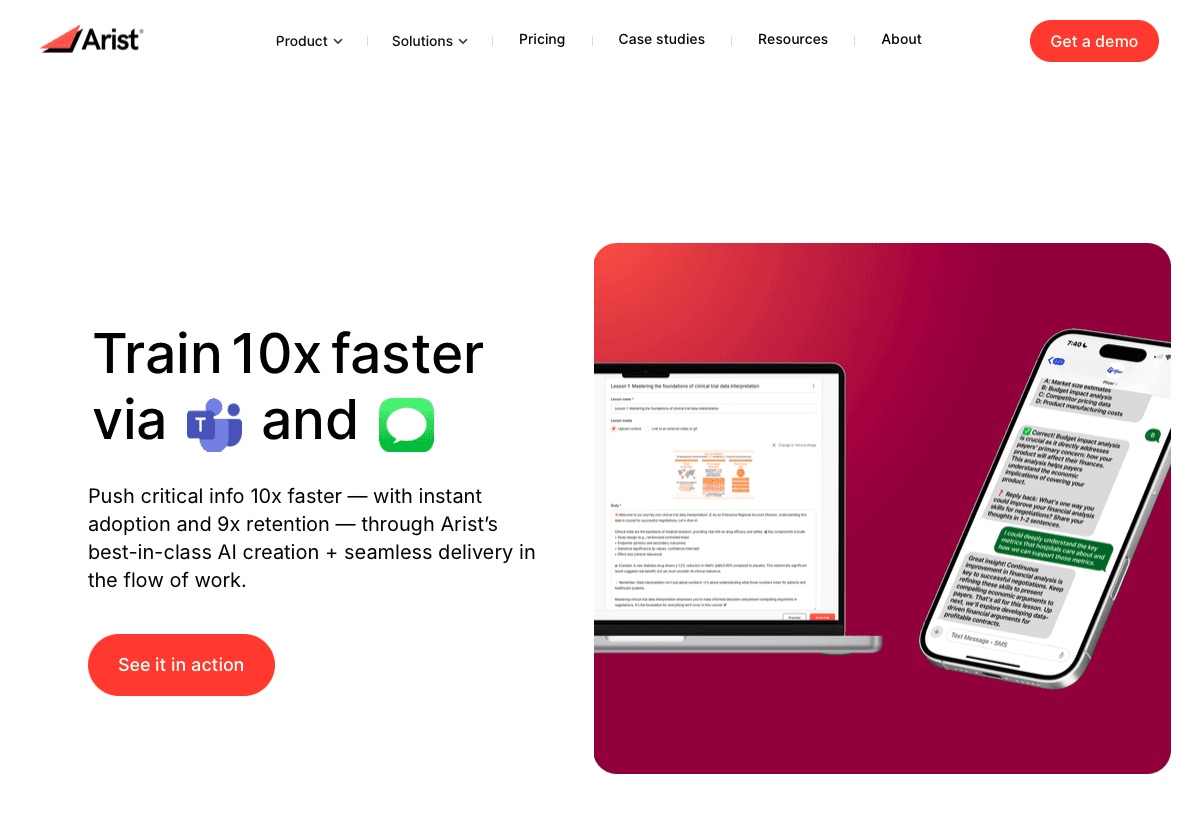
Online training solutions struggle when learning lives in portals employees rarely visit and content takes months to produce. Arist was designed for a faster model, using AI to automate the full enablement loop from needs analysis through delivery and measurement. By turning existing documents into training in hours and delivering it inside Slack, Teams, SMS, and WhatsApp, Arist brings learning directly into the flow of work where completion and retention are highest.
Arist’s Agent Suite works as a coordinated system. The Needs Analysis Agent identifies skill gaps through AI-driven interviews, the Creator Agent generates role-specific courses and job aids, and the Routing Agent delivers and reinforces training based on role, location, and performance. Built-in referencing and verification support regulated industries, while multilingual delivery supports global rollouts without added production time.
This model has delivered results at enterprise scale. Novo Nordisk used Arist to support the global Ozempic launch, while Wolters Kluwer trained 30,000 employees across 13 languages in three weeks. By aligning AI-driven enablement with speed, accessibility, and measurable outcomes, Arist reflects what modern online training solutions need to deliver in 2026.
FAQs
What's the difference between flow of work training and traditional LMS systems?
Flow of work training delivers lessons directly inside Teams, Slack, or SMS where employees already spend their day, achieving 95%+ completion rates. Traditional LMS systems require separate logins and portal navigation, which is why most employees only check them once every six weeks.
What ROI metrics should you track beyond completion rates?
Connect training to business outcomes like revenue per employee, time-to-productivity for new hires, safety incident reduction, and customer satisfaction scores. Track how much faster new sales reps close their first deal or how training reduces safety incidents across your operations.
Can AI-powered training maintain accuracy for regulated industries?
Yes. AI referencing agents verify content against source documents, add citations, and perform fact-checking to meet compliance requirements. Pharmaceutical companies use these systems to ingest thousands of pages of FDA documentation and create audit-ready training with built-in accuracy verification.
Final Thoughts on Scaling Corporate Learning
Online training solutions now need to match the speed and reality of modern work. The strongest options deploy in days, reach desk and deskless teams through Slack, Teams, and SMS, and connect learning activity to outcomes like revenue per rep, safety incidents, and faster ramp time. Arist fits this new standard by using AI to turn existing knowledge into targeted training and deliver it where work already happens, while giving leaders visibility into what actually changes after training rolls out. When learning reaches every employee and links back to business results, training becomes part of how companies compete and grow.
Online training solutions have earned a bad reputation by pulling employees out of their workday, locking learning behind separate logins, and charging per seat whether anyone actually engages. Teams sit through long courses, forget most of the content, and leaders are left guessing if any of it moved revenue, safety, or productivity. In 2026, that model no longer holds. The tools gaining adoption now deliver learning inside Slack, Teams, and SMS, generate courses from existing documents in hours, and tie completion data to outcomes leaders already track. In this guide, we break down what’s changed, why legacy systems fall short, and how a modern training approach fits into the way work actually gets done today.
TLDR:
Online training solutions in 2026 must deliver learning inside tools teams already use daily to hit 95%+ completion rates.
AI-powered platforms now generate courses in hours instead of weeks, cutting content creation time by 90%.
Multi-channel delivery via SMS, Teams, and Slack reaches 80% of workers who are deskless without computer access.
The global skills gap could cost $5.5 trillion by 2026, making rapid training deployment a competitive advantage.
Some solutions automate the full training loop (needs analysis, content creation, delivery, and analytics), achieving 95% adoption rates.
What Makes an Effective Online Training Solution in February 2026
The bar for effective training has moved. Hosting content and tracking completions is no longer enough. Today's training needs to change behavior, reach employees where they work, and prove business impact.
Look for solutions that deliver learning inside the tools your team already uses: messaging apps, SMS, or collaboration software. When training shows up in the flow of work instead of behind a separate login, completion rates jump to over 95%.
Speed matters too. The best solutions generate content in hours using AI to ingest your materials and create courses instantly.
Analytics should connect training to real outcomes. Can you see how learning impacts sales pipeline, safety incidents, or customer satisfaction?
AI Training Capabilities That Drive Real Business Results
AI now handles course generation from source material, conducts voice interviews to identify skill gaps, and builds personalized learning paths based on role and performance data.
This automation solves a critical problem: 38% of AI adoption challenges come from insufficient training in AI tools. The best solutions instantly translate content into 50+ languages, verify accuracy against source documents, and adapt reinforcement based on learner responses.
The impact shows in deployment speed. What consultants used to deliver in six weeks can now take four hours, with automated fact-checking maintaining accuracy while personalizing delivery across sales reps, medical science liaisons, and executives.
Flow of Work Training vs. Traditional LMS Approaches
Traditional LMS systems pull employees out of their workflow, requiring separate logins, portal navigation, and dedicated computer time. Many employees only check their LMS every few weeks.
Flow of work training delivers lessons directly inside messaging tools teams already use daily. A sales rep gets a lesson in Teams between calls. A warehouse worker receives safety updates via SMS during break. No app downloads, no password resets, no context switching.
This approach matters most for frontline and deskless workers without regular computer access. SMS and WhatsApp reach them on personal or company devices without requiring portal access during shifts.
The Growing Enterprise Skills Gap and What It Means for Training Investment
IDC research projects that 90 percent of global enterprises will face critical skills shortages by 2026, potentially costing the global economy $5.5 trillion through product delays and lost revenue.
Reactive training strategies can't close gaps fast enough. By the time you identify a need, hire consultants, build content, and roll it out through traditional channels, the business context has shifted. Product launches get delayed. Competitors move faster. Revenue opportunities slip away.
Training that deploys in days reaches your entire workforce through channels they already use daily. The cost of slow training now exceeds the investment in faster alternatives.
Multi-Channel Delivery: Reaching Desk and Deskless Workers
Roughly 80 percent of the global workforce is deskless. They work in warehouses, hospitals, retail stores, and manufacturing floors without regular access to computers or corporate portals. If your training only reaches desk workers, you're leaving most of your workforce untrained.
SMS and WhatsApp delivery solve this accessibility problem. Frontline employees receive lessons on their phones during breaks or between tasks. No computer required. No app downloads. No corporate network login.
When training can't reach your entire workforce, functional risks multiply. Safety protocols don't reach factory floors. Product knowledge stops at corporate headquarters. Compliance gaps widen across distributed teams.
Multi-channel delivery turns training into something every employee can access, regardless of where or how they work.
Training ROI: Connecting Learning to Business Outcomes
Completion rates show who finished, not what changed. Real ROI measurement connects training to business metrics: revenue per employee, time-to-productivity for new hires, safety incident reduction, and customer satisfaction scores.
94 percent of employees stay longer at companies that invest in their learning. That retention impact saves recruitment costs and preserves institutional knowledge.
Track time-to-competency reductions. If new sales reps close their first deal three weeks faster after training changes, multiply that by your average deal size and number of new hires.
Strong training analytics answer questions like "Which interventions improved manager performance last quarter?" When you can query outcomes in real-time, budget conversations shift from cost justification to growth investment.
Pricing Models for Corporate Training Solutions Explained
Per-user pricing charges monthly or annually for each active learner. This model scales linearly with headcount but can become expensive for large organizations or high-turnover roles where seats go unused.
Enterprise licensing offers flat-rate access for your entire organization regardless of size. This works well for companies over 5,000 employees where per-user math breaks down, but smaller organizations often overpay for capacity they won't use.
Cohort-based pricing charges per training group or campaign instead of individual seats. You pay for the initiative, not the headcount.
Watch for hidden costs that double your budget. Implementation fees can run $50k-$200k for complex integrations. Custom development often requires dedicated IT resources.
Calculate total cost of ownership across three years.
Pricing Model | How It Works | Best For | Key Considerations |
|---|---|---|---|
Per-User Pricing | Monthly or annual charges for each active learner, scaling linearly with headcount | Small to mid-sized organizations with stable headcount and predictable growth | Can become expensive for large teams or high-turnover roles where seats go unused |
Enterprise Licensing | Flat-rate access for entire organization regardless of size | Companies over 5,000 employees where per-user pricing becomes cost-prohibitive | Smaller organizations often overpay for capacity they won't use |
Cohort-Based Pricing | Charges per training group or campaign instead of individual seats | Organizations running targeted initiatives or project-based training programs | More cost-effective for large-scale rollouts but requires campaign planning |
Total Cost of Ownership | Base subscription plus implementation fees, custom development, IT resources, and maintenance | Accurate budget planning across multi-year contracts | Hidden costs like implementation fees can add $50k-$200k and double initial budget estimates |
Speed to Deploy: Why Launch Time Matters More Than Ever
Product launches don't wait for training cycles. When a pharmaceutical company wins FDA approval for a new therapy, field teams need knowledge immediately. Waiting months for content development means competitors educate doctors first, shaping prescribing habits before your reps get trained.
Compliance deadlines create the same pressure. Regulatory changes often give weeks, not months, to train your workforce. Solutions requiring lengthy implementation force you to choose between compliance risk or functional disruption.
Deployment speed separates companies that react from those that lead. When you can move from identifying a skill gap to delivering targeted training in 48 hours, learning becomes a competitive advantage.
Compliance and Security Considerations for Enterprise Training
Enterprise training involves sensitive employee data, proprietary content, and performance records. Weak security creates risks including data breaches, regulatory penalties, and reputational damage.
SOC 2 compliance verifies that your training solution maintains strict controls over data handling, access, and storage. GDPR readiness protects you when training European employees through clear data retention policies and deletion capabilities.
Audit trails document who accessed content, completion times, and performance data. Regulated industries require this documentation for inspections. During FDA audits, pharmaceutical companies must prove every rep completed required training before promoting medications.
Access controls restrict sensitive content by role, location, or clearance level, preventing unauthorized access to competitive intelligence.
Integration Ecosystem: Connecting Training to Your Tech Stack
Training solutions that don't connect to your existing systems create manual work. HR teams end up uploading employee rosters weekly, copying completion data into spreadsheets, and manually combining records across systems.
Native integrations with HRIS systems like Workday and SAP SuccessFactors automatically sync employee data, roles, locations, and tenure. This supports automatic cohort building based on who needs which training when. When someone changes roles, their learning path adjusts without manual updates.
Collaboration tool integrations deliver training directly inside Teams and Slack where employees already spend their day. SSO connections eliminate password friction and match your existing security policies.
How Arist Is Changing Training through AI-Driven Enablement
Online training solutions struggle when learning lives in portals employees rarely visit and content takes months to produce. Arist was designed for a faster model, using AI to automate the full enablement loop from needs analysis through delivery and measurement. By turning existing documents into training in hours and delivering it inside Slack, Teams, SMS, and WhatsApp, Arist brings learning directly into the flow of work where completion and retention are highest.
Arist’s Agent Suite works as a coordinated system. The Needs Analysis Agent identifies skill gaps through AI-driven interviews, the Creator Agent generates role-specific courses and job aids, and the Routing Agent delivers and reinforces training based on role, location, and performance. Built-in referencing and verification support regulated industries, while multilingual delivery supports global rollouts without added production time.
This model has delivered results at enterprise scale. Novo Nordisk used Arist to support the global Ozempic launch, while Wolters Kluwer trained 30,000 employees across 13 languages in three weeks. By aligning AI-driven enablement with speed, accessibility, and measurable outcomes, Arist reflects what modern online training solutions need to deliver in 2026.
FAQs
What's the difference between flow of work training and traditional LMS systems?
Flow of work training delivers lessons directly inside Teams, Slack, or SMS where employees already spend their day, achieving 95%+ completion rates. Traditional LMS systems require separate logins and portal navigation, which is why most employees only check them once every six weeks.
What ROI metrics should you track beyond completion rates?
Connect training to business outcomes like revenue per employee, time-to-productivity for new hires, safety incident reduction, and customer satisfaction scores. Track how much faster new sales reps close their first deal or how training reduces safety incidents across your operations.
Can AI-powered training maintain accuracy for regulated industries?
Yes. AI referencing agents verify content against source documents, add citations, and perform fact-checking to meet compliance requirements. Pharmaceutical companies use these systems to ingest thousands of pages of FDA documentation and create audit-ready training with built-in accuracy verification.
Final Thoughts on Scaling Corporate Learning
Online training solutions now need to match the speed and reality of modern work. The strongest options deploy in days, reach desk and deskless teams through Slack, Teams, and SMS, and connect learning activity to outcomes like revenue per rep, safety incidents, and faster ramp time. Arist fits this new standard by using AI to turn existing knowledge into targeted training and deliver it where work already happens, while giving leaders visibility into what actually changes after training rolls out. When learning reaches every employee and links back to business results, training becomes part of how companies compete and grow.
Related Resources

Article
AI Upskilling: A Practical Guide for Building Your Team in June 2026
Learn how to build AI upskilling programs that drive behavior change. Practical guide with frameworks, metrics, and proven strategies for June 2026.
Read more
Article
Salesforce Training for Beginners: Complete June 2026 Guide
Complete Salesforce training for beginners in June 2026. Learn Trailhead, certifications, admin paths, and career options with this full overview.
Read more
Bring real impact to your people
We care about solving meaningful problems and being thought partners first and foremost. Arist is used and loved by the Fortune 500 — and we'd love to support your goals.
Curious to get a demo or free trial? We'd love to chat:

Bring real impact to your people
We care about solving meaningful problems and being thought partners first and foremost. Arist is used and loved by the Fortune 500 — and we'd love to support your goals.
Curious to get a demo or free trial? We'd love to chat:
Bring real impact to your people
We care about solving meaningful problems and being thought partners first and foremost. Arist is used and loved by the Fortune 500 — and we'd love to support your goals.
Curious to get a demo or free trial? We'd love to chat: