Training and Communication: 7 Essential Strategies for January 2026
Training and Communication: 7 Essential Strategies for January 2026

Learn 7 training and communication strategies for January 2026. Microlearning, active listening, and SMS training boost completion rates to 95%+ for all teams.
Most communication problems at work don’t come from apathy or bad intent; they come from outdated training and communication models that no longer reflect how people actually learn or work today. Long workshops, dense slide decks, and one-off sessions ask employees to pause their jobs without giving them tools they can rely on under pressure. Real improvement happens when training and communication skills are taught in short bursts, reinforced over time, and practiced in real situations as they happen. That’s why many organizations are moving toward a new, in-the-flow approach to training and communication that fits into daily routines instead of pulling people away from them.
TLDR:
Active listening and spaced microlearning considerably reduce workplace errors caused by poor communication.
Flow-of-work training via SMS, Teams, and Slack achieves 95%+ completion vs. 30% for traditional LMS.
Frontline workers represent 70-80% of the workforce but rarely get accessible training.
Role-playing and simulations build real-time response skills better than reading alone.
Some modern solutions deliver AI-powered communication training through messaging apps with automated reinforcement.
Active Listening: The Foundation of Effective Communication Training
Surveys report that 86% of employees and executives cite poor collaboration and communication as a primary reason workplace errors happen. Many of those failures stem from incomplete listening.
Training employees to listen actively requires breaking the skill into teachable components:
Maintaining eye contact to signal engagement and respect for the speaker
Paraphrasing what you heard to confirm understanding before responding
Asking clarifying questions that dig deeper into ambiguous points
Withholding judgment until the speaker finishes their complete thought
A single workshop won't rewire habits formed over decades. Short, repeated lessons delivered over weeks help learners internalize active listening techniques until they become automatic. When training reaches every level of the organization, from executives to frontline staff, miscommunication drops sharply.
Building Communication Skills through Microlearning and Reinforcement
Traditional workshops often fail because they pack information into concentrated sessions. Without reinforcement, employees forget a considerable portion of training content over time. Microlearning modules show 80% higher completion rates by breaking skills into five-minute lessons spread over time.
One session covers writing clearer emails. Three days later, learners practice structuring difficult conversations. A week after that, they get a refresher with new scenarios that test retention. Spacing lessons over time works better than cramming everything into one day.
Short lessons fit into busy schedules and respect attention spans. Learners apply new skills immediately, then receive another lesson before the knowledge fades. Brief messages delivered during the workday get finished instead of ignored.
Personalized Training Delivery through Flow-of-Work Learning
Employees skip training when it requires logging into separate systems. Flow-of-work learning sends training directly into Slack, Teams, or SMS where people already spend their day.
A three-minute lesson on giving feedback arrives as a Teams message during morning coffee. A reminder about written communication appears in Slack before a presentation. Frontline staff receive SMS lessons on their phones between shifts.
Only 9% of non-desk employees report satisfaction with internal communication. Delivering lessons through messaging apps closes this gap by reaching learners where they already work.
Personalization drives completion rates higher. Sales teams get scenarios about client conversations. Managers receive content on handling tough feedback. New hires see onboarding lessons paced to their start date. When training adapts to role and experience level, completion rates often rise dramatically, especially when lessons are delivered in the flow of work.
Leadership Communication Training to Drive Employee Engagement
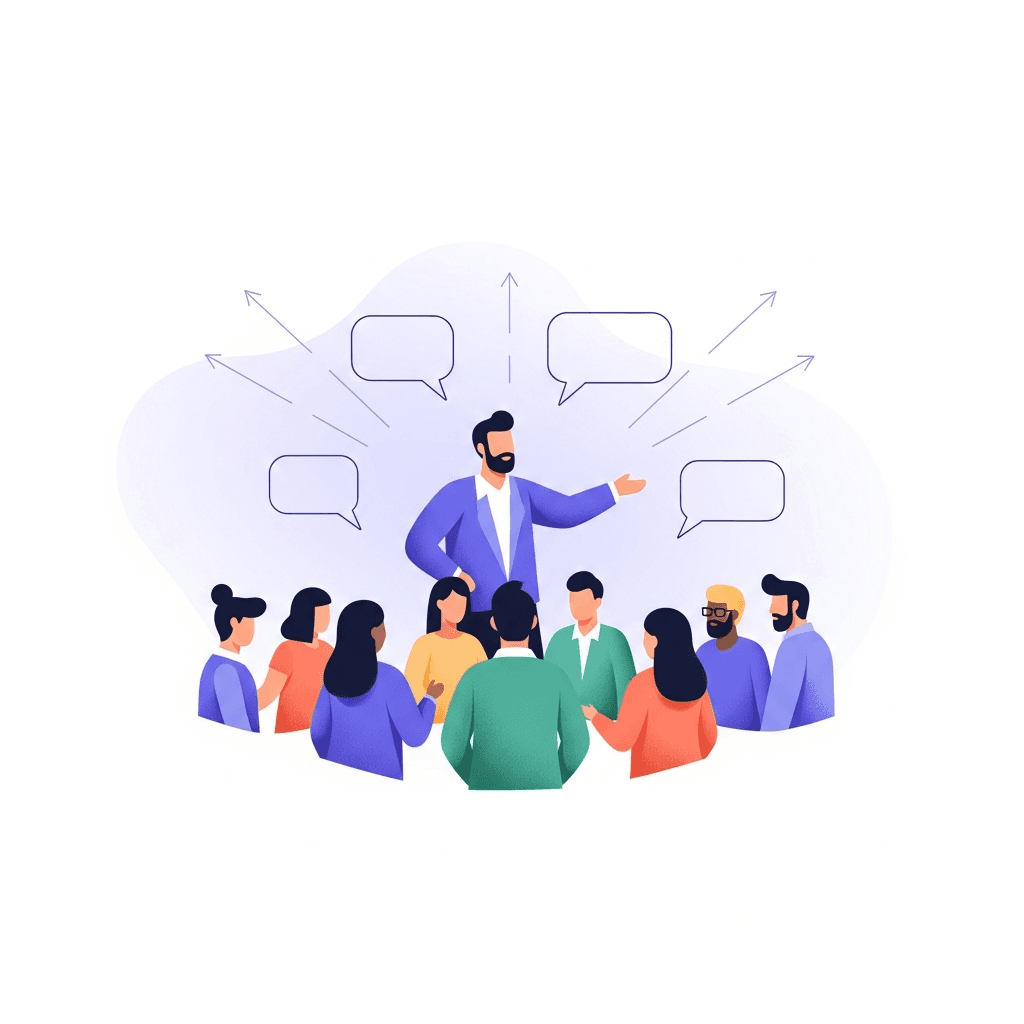
Leaders shape how information flows across teams. When managers communicate goals, expectations, and feedback clearly, teams remain engaged and aligned.
Estimates suggest that miscommunication costs U.S. businesses over $1 trillion annually through lost productivity, errors, and increased turnover. Leadership communication gaps can be a major driver of these costs. Managers who withhold context, provide vague direction, or sidestep difficult conversations create confusion across entire teams.
Leadership training should focus on real situations managers encounter daily:
Delivering constructive feedback without discouraging direct reports
Communicating organizational changes while minimizing resistance
Recognizing team contributions authentically
Microlearning fits leaders who can't attend multi-day workshops. A five-minute lesson on structuring one-on-ones arrives before their next meeting. A quick reminder about transparent communication appears before announcing reorganization plans.
Training Frontline and Deskless Workers: Overcoming Access Barriers
Deskless workers represent 70 to 80% of the global workforce but rarely receive training that fits their reality. Retail staff, warehouse workers, healthcare teams, and field technicians often lack corporate email and computer access during shifts.
SMS-based training solves this by delivering lessons directly to personal or company phones. No app downloads, no login credentials. Workers engage during breaks or between tasks without extra steps.
Shift-friendly scheduling sends lessons after clock-in or during break windows. Follow-up messages wait until the next shift begins. Workers control timing through opt-in preferences, avoiding notifications during off-hours.
WhatsApp serves international teams well. Toll-free SMS numbers prevent cost barriers. Short lessons respect limited break time and competing demands. When training reaches workers where they already are, completion rates can approach those of desk-based employees.
Measuring Communication Training Effectiveness and Behavior Change
Completion rates show who finished training, not who changed behavior. Track observable actions instead: Does a manager now hold regular one-on-ones? Do service reps resolve issues faster? These signal real skill development.
Connect training to business results. Teams with strong communication see up to 25% higher productivity. Track retention rates before and after leadership training. Monitor customer satisfaction following service team courses. Compare error rates between trained and untrained teams.
Real-time dashboards should answer: Which departments show behavior change? How does completion correspond with performance gains? Analytics linking learning to business KPIs prove ROI and reveal where refinement is needed.
Self-reported confidence isn't enough. Combine surveys with manager observations, peer feedback, and performance data for a complete view.
Role-Playing, Simulation, and Practice-Based Communication Training
Reading about communication differs from practicing under pressure. Role-playing builds muscle memory by placing learners in realistic scenarios where they must respond in real time.
Sales teams practice handling price objections. Managers rehearse delivering negative feedback. Customer service reps work through angry caller simulations. Repeating these scenarios in safe environments reduces anxiety when real situations arise.
Simulations should mirror actual workplace pressure. Time constraints force quick thinking. Ambiguous instructions test clarification skills. Conflicting priorities require negotiation. Feedback arrives immediately, focusing on what worked and what missed.
Practice sessions build confidence through repetition. The first role-play feels awkward. By the fifth iteration, responses become smoother. Learners develop instincts for reading tone, adjusting messages mid-conversation, and recovering from missteps.
Cross-functional scenarios prepare teams for collaboration friction. Engineers practice explaining technical concepts to non-technical stakeholders. Finance teams rehearse budget discussions with resistant managers. These exercises surface assumptions and communication gaps before they derail projects.
How Arist Changes Communication Training with AI-Driven Microlearning
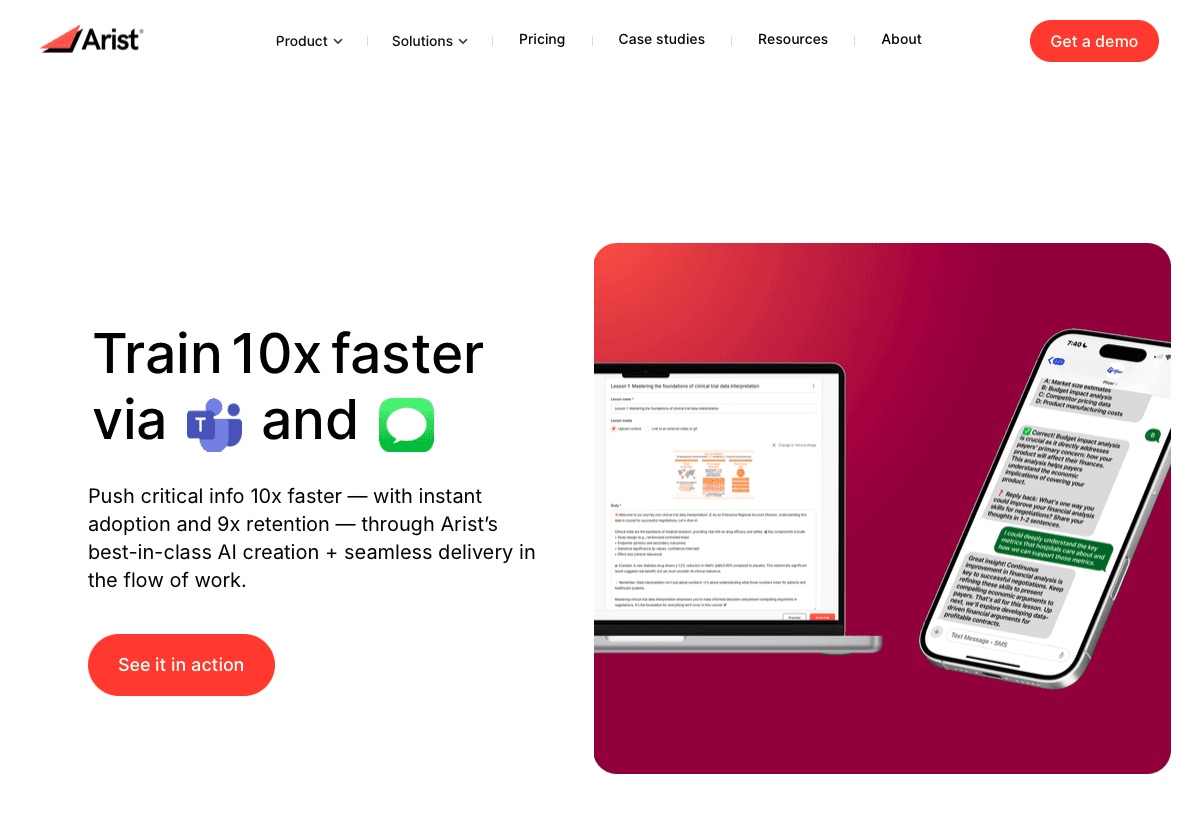
Arist automates communication training through AI agents that create, deliver, and measure learning in the channels you already use.
Our Creator Agent builds personalized communication lessons from your existing content in minutes. The Routing Agent sends them through SMS, WhatsApp, Teams, or Slack based on role, shift schedule, and available learner signals (like participation and responses). Frontline workers receive training on their phones between shifts without app downloads or logins.
Spaced reinforcement happens automatically. A lesson on active listening arrives today. A scenario-based quiz follows three days later. A refresher appears next week. Our Analytics Agent tracks behavior change, linking communication skills to retention rates, customer satisfaction, and error reduction.
You reach desk and deskless employees with completion rates above 95%.
FAQs
How long does it take to see behavior change from communication training?
Early behavior change often begins within the first few weeks when using spaced microlearning, with measurable performance improvements appearing as reinforcement continues.
What makes SMS-based training work better for frontline workers than traditional methods?
SMS training requires no app downloads, logins, or computer access; lessons arrive directly on phones workers already carry, fitting naturally into breaks and shift transitions without creating barriers.
How can I measure whether communication training actually improved workplace performance?
Track observable actions like meeting frequency, issue resolution speed, and error rates before and after training, then connect these metrics to business outcomes like retention, productivity, and customer satisfaction scores.
When should managers receive communication training versus frontline staff?
Both groups need training simultaneously; managers learn to deliver clear direction and feedback while frontline staff develop active listening and clarification skills, creating alignment across the organization.
Can microlearning replace full-day communication workshops?
Yes. Five-minute lessons spaced over weeks produce 80% higher completion rates and better retention than single-day workshops because learners apply skills immediately and receive reinforcement before knowledge fades.
Final Thoughts on Strengthening Team Communication
Training and communication succeed when they respect how people actually work instead of adding another system to log into. Short lessons delivered over time help skills form through repetition, while practice inside the tools teams already use makes those skills usable in the moments that matter. Arist was built around this reality, delivering communication training through everyday channels so learning happens alongside the job, not on top of it. Organizations that start with a focused pilot often see faster alignment, fewer errors, and clearer conversations across roles. If your goal is lasting behavior change, investing in modern communication training that works in the flow of work is a practical place to start.
Most communication problems at work don’t come from apathy or bad intent; they come from outdated training and communication models that no longer reflect how people actually learn or work today. Long workshops, dense slide decks, and one-off sessions ask employees to pause their jobs without giving them tools they can rely on under pressure. Real improvement happens when training and communication skills are taught in short bursts, reinforced over time, and practiced in real situations as they happen. That’s why many organizations are moving toward a new, in-the-flow approach to training and communication that fits into daily routines instead of pulling people away from them.
TLDR:
Active listening and spaced microlearning considerably reduce workplace errors caused by poor communication.
Flow-of-work training via SMS, Teams, and Slack achieves 95%+ completion vs. 30% for traditional LMS.
Frontline workers represent 70-80% of the workforce but rarely get accessible training.
Role-playing and simulations build real-time response skills better than reading alone.
Some modern solutions deliver AI-powered communication training through messaging apps with automated reinforcement.
Active Listening: The Foundation of Effective Communication Training
Surveys report that 86% of employees and executives cite poor collaboration and communication as a primary reason workplace errors happen. Many of those failures stem from incomplete listening.
Training employees to listen actively requires breaking the skill into teachable components:
Maintaining eye contact to signal engagement and respect for the speaker
Paraphrasing what you heard to confirm understanding before responding
Asking clarifying questions that dig deeper into ambiguous points
Withholding judgment until the speaker finishes their complete thought
A single workshop won't rewire habits formed over decades. Short, repeated lessons delivered over weeks help learners internalize active listening techniques until they become automatic. When training reaches every level of the organization, from executives to frontline staff, miscommunication drops sharply.
Building Communication Skills through Microlearning and Reinforcement
Traditional workshops often fail because they pack information into concentrated sessions. Without reinforcement, employees forget a considerable portion of training content over time. Microlearning modules show 80% higher completion rates by breaking skills into five-minute lessons spread over time.
One session covers writing clearer emails. Three days later, learners practice structuring difficult conversations. A week after that, they get a refresher with new scenarios that test retention. Spacing lessons over time works better than cramming everything into one day.
Short lessons fit into busy schedules and respect attention spans. Learners apply new skills immediately, then receive another lesson before the knowledge fades. Brief messages delivered during the workday get finished instead of ignored.
Personalized Training Delivery through Flow-of-Work Learning
Employees skip training when it requires logging into separate systems. Flow-of-work learning sends training directly into Slack, Teams, or SMS where people already spend their day.
A three-minute lesson on giving feedback arrives as a Teams message during morning coffee. A reminder about written communication appears in Slack before a presentation. Frontline staff receive SMS lessons on their phones between shifts.
Only 9% of non-desk employees report satisfaction with internal communication. Delivering lessons through messaging apps closes this gap by reaching learners where they already work.
Personalization drives completion rates higher. Sales teams get scenarios about client conversations. Managers receive content on handling tough feedback. New hires see onboarding lessons paced to their start date. When training adapts to role and experience level, completion rates often rise dramatically, especially when lessons are delivered in the flow of work.
Leadership Communication Training to Drive Employee Engagement
Leaders shape how information flows across teams. When managers communicate goals, expectations, and feedback clearly, teams remain engaged and aligned.
Estimates suggest that miscommunication costs U.S. businesses over $1 trillion annually through lost productivity, errors, and increased turnover. Leadership communication gaps can be a major driver of these costs. Managers who withhold context, provide vague direction, or sidestep difficult conversations create confusion across entire teams.
Leadership training should focus on real situations managers encounter daily:
Delivering constructive feedback without discouraging direct reports
Communicating organizational changes while minimizing resistance
Recognizing team contributions authentically
Microlearning fits leaders who can't attend multi-day workshops. A five-minute lesson on structuring one-on-ones arrives before their next meeting. A quick reminder about transparent communication appears before announcing reorganization plans.
Training Frontline and Deskless Workers: Overcoming Access Barriers
Deskless workers represent 70 to 80% of the global workforce but rarely receive training that fits their reality. Retail staff, warehouse workers, healthcare teams, and field technicians often lack corporate email and computer access during shifts.
SMS-based training solves this by delivering lessons directly to personal or company phones. No app downloads, no login credentials. Workers engage during breaks or between tasks without extra steps.
Shift-friendly scheduling sends lessons after clock-in or during break windows. Follow-up messages wait until the next shift begins. Workers control timing through opt-in preferences, avoiding notifications during off-hours.
WhatsApp serves international teams well. Toll-free SMS numbers prevent cost barriers. Short lessons respect limited break time and competing demands. When training reaches workers where they already are, completion rates can approach those of desk-based employees.
Measuring Communication Training Effectiveness and Behavior Change
Completion rates show who finished training, not who changed behavior. Track observable actions instead: Does a manager now hold regular one-on-ones? Do service reps resolve issues faster? These signal real skill development.
Connect training to business results. Teams with strong communication see up to 25% higher productivity. Track retention rates before and after leadership training. Monitor customer satisfaction following service team courses. Compare error rates between trained and untrained teams.
Real-time dashboards should answer: Which departments show behavior change? How does completion correspond with performance gains? Analytics linking learning to business KPIs prove ROI and reveal where refinement is needed.
Self-reported confidence isn't enough. Combine surveys with manager observations, peer feedback, and performance data for a complete view.
Role-Playing, Simulation, and Practice-Based Communication Training
Reading about communication differs from practicing under pressure. Role-playing builds muscle memory by placing learners in realistic scenarios where they must respond in real time.
Sales teams practice handling price objections. Managers rehearse delivering negative feedback. Customer service reps work through angry caller simulations. Repeating these scenarios in safe environments reduces anxiety when real situations arise.
Simulations should mirror actual workplace pressure. Time constraints force quick thinking. Ambiguous instructions test clarification skills. Conflicting priorities require negotiation. Feedback arrives immediately, focusing on what worked and what missed.
Practice sessions build confidence through repetition. The first role-play feels awkward. By the fifth iteration, responses become smoother. Learners develop instincts for reading tone, adjusting messages mid-conversation, and recovering from missteps.
Cross-functional scenarios prepare teams for collaboration friction. Engineers practice explaining technical concepts to non-technical stakeholders. Finance teams rehearse budget discussions with resistant managers. These exercises surface assumptions and communication gaps before they derail projects.
How Arist Changes Communication Training with AI-Driven Microlearning
Arist automates communication training through AI agents that create, deliver, and measure learning in the channels you already use.
Our Creator Agent builds personalized communication lessons from your existing content in minutes. The Routing Agent sends them through SMS, WhatsApp, Teams, or Slack based on role, shift schedule, and available learner signals (like participation and responses). Frontline workers receive training on their phones between shifts without app downloads or logins.
Spaced reinforcement happens automatically. A lesson on active listening arrives today. A scenario-based quiz follows three days later. A refresher appears next week. Our Analytics Agent tracks behavior change, linking communication skills to retention rates, customer satisfaction, and error reduction.
You reach desk and deskless employees with completion rates above 95%.
FAQs
How long does it take to see behavior change from communication training?
Early behavior change often begins within the first few weeks when using spaced microlearning, with measurable performance improvements appearing as reinforcement continues.
What makes SMS-based training work better for frontline workers than traditional methods?
SMS training requires no app downloads, logins, or computer access; lessons arrive directly on phones workers already carry, fitting naturally into breaks and shift transitions without creating barriers.
How can I measure whether communication training actually improved workplace performance?
Track observable actions like meeting frequency, issue resolution speed, and error rates before and after training, then connect these metrics to business outcomes like retention, productivity, and customer satisfaction scores.
When should managers receive communication training versus frontline staff?
Both groups need training simultaneously; managers learn to deliver clear direction and feedback while frontline staff develop active listening and clarification skills, creating alignment across the organization.
Can microlearning replace full-day communication workshops?
Yes. Five-minute lessons spaced over weeks produce 80% higher completion rates and better retention than single-day workshops because learners apply skills immediately and receive reinforcement before knowledge fades.
Final Thoughts on Strengthening Team Communication
Training and communication succeed when they respect how people actually work instead of adding another system to log into. Short lessons delivered over time help skills form through repetition, while practice inside the tools teams already use makes those skills usable in the moments that matter. Arist was built around this reality, delivering communication training through everyday channels so learning happens alongside the job, not on top of it. Organizations that start with a focused pilot often see faster alignment, fewer errors, and clearer conversations across roles. If your goal is lasting behavior change, investing in modern communication training that works in the flow of work is a practical place to start.
Related Resources

Article
AI Upskilling: A Practical Guide for Building Your Team in June 2026
Learn how to build AI upskilling programs that drive behavior change. Practical guide with frameworks, metrics, and proven strategies for June 2026.
Read more
Article
Salesforce Training for Beginners: Complete June 2026 Guide
Complete Salesforce training for beginners in June 2026. Learn Trailhead, certifications, admin paths, and career options with this full overview.
Read more
Bring real impact to your people
We care about solving meaningful problems and being thought partners first and foremost. Arist is used and loved by the Fortune 500 — and we'd love to support your goals.
Curious to get a demo or free trial? We'd love to chat:

Bring real impact to your people
We care about solving meaningful problems and being thought partners first and foremost. Arist is used and loved by the Fortune 500 — and we'd love to support your goals.
Curious to get a demo or free trial? We'd love to chat:
Bring real impact to your people
We care about solving meaningful problems and being thought partners first and foremost. Arist is used and loved by the Fortune 500 — and we'd love to support your goals.
Curious to get a demo or free trial? We'd love to chat: