What does a winning learning organization look like?
What does a winning learning organization look like?
Discover how to structure a winning learning organization with the right teams, budgets, and strategies to boost retention and revenue in December 2021.
What does a winning learning organization actually look like today? It isn’t defined by how many courses exist or how full the training calendar appears, but by whether learning changes daily behavior and shows up in metrics leaders already track, like retention, revenue, and speed to productivity. In 2026, this matters more than ever, with a significant share of employees saying they would consider leaving a company that offers no learning or growth opportunities. High-performing organizations treat learning as a living system, not an event, something continuous, measurable, and embedded directly into how work gets done. Modern approaches make that possible by pushing development into everyday workflows instead of pulling employees into separate portals. When learning operates this way, it stops being a cost center and starts functioning like core business infrastructure.
TLDR:
Learning organizations tie training to business outcomes like retention and quota attainment, not completion rates.
Microlearning hits 80% completion vs 20% for traditional courses by removing friction and delivering in-flow.
Effective L&D teams need three core functions: operations, instructional design, and analytics.
Organizations spend $1,200–$1,500 per employee annually on learning; connect that investment directly to reductions in employee turnover.
Certain solutions deliver AI-powered microlearning through SMS, Teams, and Slack with 95%+ completion rates.
What a Learning Organization Actually Is (And Why It Matters in 2026)
A learning organization isn't a library of courses or a training calendar. It's a system designed to change behavior and drive business results. The difference matters because one collects dust while the other moves revenue, retention, and readiness.
In 2026, that distinction has become existential. A significant number of employees reportedly say they would consider leaving a company that offers no learning or growth opportunities.
The best learning organizations treat development the way engineering teams treat deployment: continuous, measured, and embedded in daily work. They don't run annual training events. They build feedback loops that improve skills in real time and tie those improvements to outcomes like quota attainment, time-to-productivity, and internal mobility rates.
The Core Roles That Make Up a High-Functioning L&D Team
Every effective learning organization relies on three core functions, whether those functions live in three people or thirty.
First, you need coordinators who handle logistics, scheduling, and delivery. They manage learning calendars, track completions, and route content to the right cohorts.
Then comes instructional design. These are the people who convert business needs into actual learning experiences. They structure content, write assessments, and design reinforcement loops.
The third leg is analytics. Analysts translate activity into insight by measuring completion, retention, behavior change, and business impact. They answer questions like whether onboarding actually shortens time-to-quota or if compliance training reduces incidents.
As organizations mature, these roles specialize further. You might add learning technologists who manage integrations, or content strategists who govern quality across teams. But the foundation stays the same: operations, design, and measurement working together.
Budget Reality: What L&D Actually Costs
L&D budgets are growing, but so is scrutiny. Organizations are projecting continued growth in training spend, with leadership development increasing faster than most other learning categories. Yet 53% of L&D professionals cite economic uncertainty and rising costs as their top challenges.
Most enterprises spend between $1,200 and $1,500 per employee annually on learning. That number climbs in regulated industries where compliance adds mandatory training cycles.
The strongest way to explain learning spend is to stop treating it as overhead. Frame learning as a retention lever first. Replacing an employee costs 50-200% of their salary. If your learning programs reduce turnover by even 5%, the ROI is immediate and measurable.
Revenue impact matters too. Organizations that link enablement to deal velocity or win rates get budget increases. The ones treating learning as a checkbox get cut first when headcount freezes hit.
Three Ways to Structure Your Learning Organization: Centralized, Decentralized, and Hybrid
Most organizations pick their L&D structure by accident. They hire a few people, assign them to HR or a business unit, and call it done. The right structure depends on scale, speed requirements, and how much consistency you need across teams.
Centralized
One central team owns all learning strategy, content creation, and delivery. This works well for regulated industries that need audit-ready consistency and smaller organizations where a specialized team of three to five people can serve the entire company more efficiently than scattered part-timers.
The downside is speed. Central teams become bottlenecks when demand exceeds capacity. Business units wait weeks for custom content, so they either build shadow solutions or skip training entirely.
Decentralized
Each department owns its own learning function. Sales builds sales training. Engineering runs technical onboarding. HR handles compliance.
You get speed and relevance. Teams create exactly what they need without waiting in a queue. But quality varies wildly. Duplication is rampant. Three teams might build three onboarding programs that contradict each other.
Hybrid
A central team sets strategy, standards, and shared infrastructure. Business units execute and customize within that framework.
This model scales best for enterprises. Central L&D provides tools, templates, and governance. They might run company-wide onboarding and compliance. Meanwhile, sales enablement, product training, and technical skills live closer to the teams that need them.
The tradeoff is complexity. You need clear ownership boundaries and strong communication, or you end up with turf wars and duplicated effort.
The Maturity Model: How Learning Organizations Evolve over Time
Learning organizations don't appear fully formed. They evolve through predictable stages as business needs and internal capabilities grow.
Stage 1: Reactive
Training happens when something breaks. A compliance audit triggers a scramble. A product launch needs enablement three days before go-live. L&D is a one-person team fielding requests with no time to plan ahead.
At this stage, you're using spreadsheets, email, and maybe a basic LMS that nobody logs into. Completion tracking is manual.
Stage 2: Structured
You've built a training calendar. Onboarding has a process. Compliance runs on a schedule. L&D has grown to a small team with defined roles and workflows.
Tools get more sophisticated. You might have an LMS, a content authoring tool, and basic reporting. But creation is still slow, and delivery requires learners to go somewhere else to complete training.
Stage 3: Strategic
Learning ties directly to business goals. You're measuring retention, behavior change, and impact on KPIs like quota attainment or time-to-productivity. Content is personalized by role and delivered where people actually work.
Automation handles repetitive tasks like scheduling and routing. Integration with HRIS systems means cohorts update automatically. You're running reinforcement loops, not one-time events.
Stage 4: Continuous
Learning and work are indistinguishable. Training happens in the flow through messaging tools. AI can support content creation, delivery, and measurement. The system adapts in real time based on performance data and business changes.
Many organizations struggle to reach this stage due to the infrastructure and automation required. But the ones that do report completion rates above 95% and measurably faster skill development.
Why Microlearning and In-the-Flow Learning Outperform Traditional Training
Traditional training asks people to stop working and go somewhere else to learn. Long-form learning modules average just 20% completion rates, while microlearning courses hit 80%. The gap isn't about attention spans. It's about friction.
When you require employees to block an hour, open a separate portal, and sit through a full course, you're competing with every other priority in their day. Microlearning removes that friction by delivering 5-minute lessons directly in the tools people already use.
In-the-flow learning takes this further by delivering lessons right where work happens. A sales rep gets product updates between customer calls in Slack. A frontline worker receives safety reminders during their shift via SMS. The learning happens when the context is fresh and the need is immediate.
How to Measure What Actually Matters: Moving beyond Completion Rates
Completion rates show attendance, not outcomes. "We trained 5,000 people" doesn't win budget battles anymore.
Behavior change is what counts. Did sales reps adopt the new pitch framework? Did support response times improve after communication training? Did managers hold better one-on-ones? If no, the training failed.
The cleanest proof of impact is tying learning to business KPIs executives already track:
Link onboarding programs to revenue per new hire in their first six months
Connect leadership development to internal promotion rates or team turnover
Map product training to win rates or deal velocity
Track whether service training reduces complaint volume or improves NPS scores
Measure if technical certification programs lower support ticket resolution time
These connections turn L&D from a cost center into a revenue driver. Walk into a budget meeting and say "our enablement program increased quota attainment by 12%" instead of "we had 94% course completion." One gets you a bigger budget. The other gets you questioned.
Where Arist Puts This into Practice
Most organizations understand what a modern learning organization should look like. Very few can operate it.
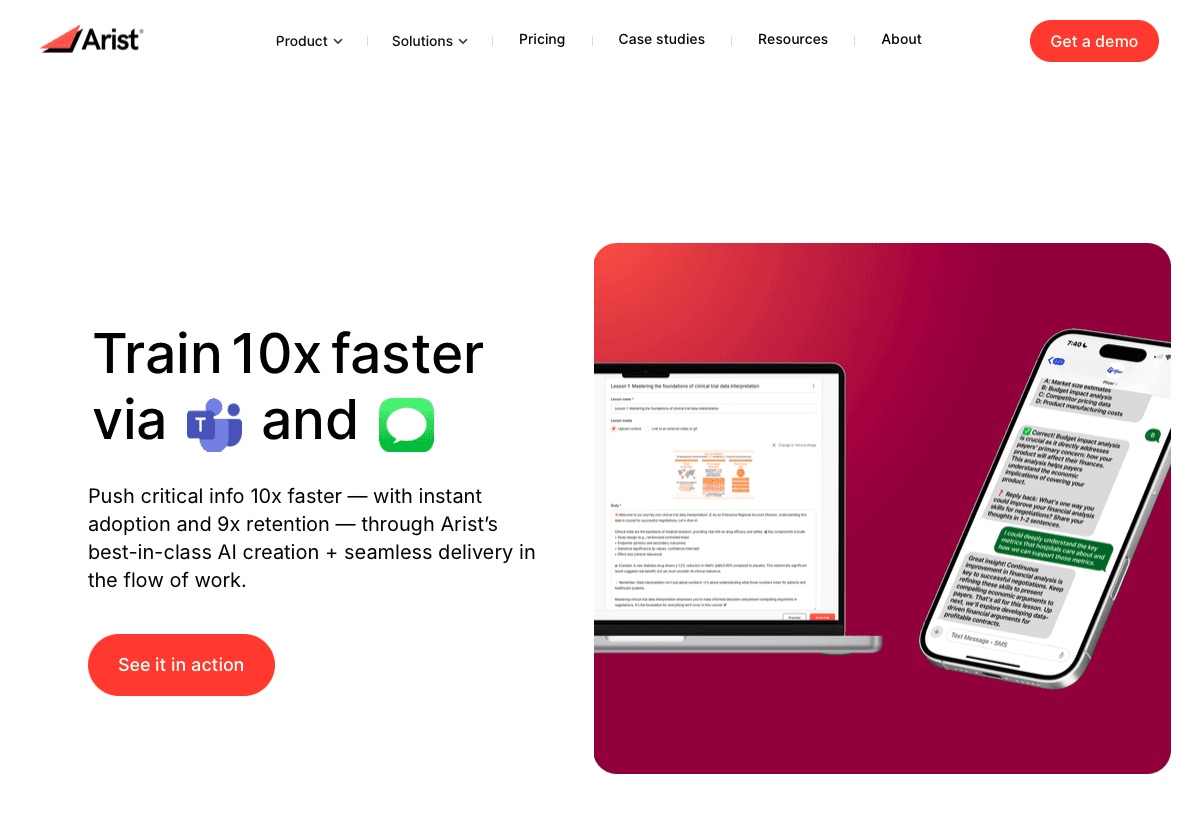
Arist exists to close that gap. It’s an AI-driven learning and enablement software built to run continuous development directly inside SMS, Teams, Slack, and WhatsApp, where work already happens. Instead of portals, calendars, and manual workflows, Arist automates needs analysis, content creation, delivery, reinforcement, and analytics through a single system.
This turns learning into infrastructure, not an event. Onboarding, compliance, sales enablement, leadership development, and change management all run through the same engine, personalized by role and performance data, and reinforced over time.
The result is 95%+ completion rates, dramatically faster rollout, and measurable impact on retention, productivity, and revenue. That’s why enterprises like Microsoft, Pfizer, Eli Lilly, and Ford use Arist to empower learning at scale.
In practice, Arist is what a learning organization looks like when it’s built to actually run.
FAQs
How do I measure if learning programs actually change behavior?
Track business metrics that matter to executives: quota attainment for sales training, time-to-productivity for onboarding, incident reduction for compliance, or internal promotion rates for leadership development. If those numbers don't move, the training didn't work.
What's the difference between a centralized and hybrid L&D structure?
Centralized means one team owns all learning strategy and delivery, which works well for smaller companies or regulated industries needing consistency. Hybrid splits ownership, central L&D sets standards and infrastructure while business units create and deliver their own content within that framework.
When should I switch from traditional training to microlearning?
If your completion rates sit below 30% or employees consistently say they don't have time for training, microlearning delivered in messaging tools (Teams, Slack, SMS) will get you to 80%+ completion by removing the friction of separate logins and long sessions.
Final Thoughts on Building Your Learning Organization
A learning organization earns its place when it proves it can change how people perform and how the business performs alongside them. The fastest path forward is to anchor learning to one outcome leaders already care about (retention, time-to-productivity, quota attainment) and build from there. As systems mature, learning changes from isolated programs to a continuous loop of skill development, reinforcement, and measurement inside daily work. Solutions like Arist’s chat-based learning model make this shift practical by embedding development directly into the flow of work and tying it back to real metrics. When learning shows clear impact on results, it stops being optional and becomes core infrastructure for growth.
What does a winning learning organization actually look like today? It isn’t defined by how many courses exist or how full the training calendar appears, but by whether learning changes daily behavior and shows up in metrics leaders already track, like retention, revenue, and speed to productivity. In 2026, this matters more than ever, with a significant share of employees saying they would consider leaving a company that offers no learning or growth opportunities. High-performing organizations treat learning as a living system, not an event, something continuous, measurable, and embedded directly into how work gets done. Modern approaches make that possible by pushing development into everyday workflows instead of pulling employees into separate portals. When learning operates this way, it stops being a cost center and starts functioning like core business infrastructure.
TLDR:
Learning organizations tie training to business outcomes like retention and quota attainment, not completion rates.
Microlearning hits 80% completion vs 20% for traditional courses by removing friction and delivering in-flow.
Effective L&D teams need three core functions: operations, instructional design, and analytics.
Organizations spend $1,200–$1,500 per employee annually on learning; connect that investment directly to reductions in employee turnover.
Certain solutions deliver AI-powered microlearning through SMS, Teams, and Slack with 95%+ completion rates.
What a Learning Organization Actually Is (And Why It Matters in 2026)
A learning organization isn't a library of courses or a training calendar. It's a system designed to change behavior and drive business results. The difference matters because one collects dust while the other moves revenue, retention, and readiness.
In 2026, that distinction has become existential. A significant number of employees reportedly say they would consider leaving a company that offers no learning or growth opportunities.
The best learning organizations treat development the way engineering teams treat deployment: continuous, measured, and embedded in daily work. They don't run annual training events. They build feedback loops that improve skills in real time and tie those improvements to outcomes like quota attainment, time-to-productivity, and internal mobility rates.
The Core Roles That Make Up a High-Functioning L&D Team
Every effective learning organization relies on three core functions, whether those functions live in three people or thirty.
First, you need coordinators who handle logistics, scheduling, and delivery. They manage learning calendars, track completions, and route content to the right cohorts.
Then comes instructional design. These are the people who convert business needs into actual learning experiences. They structure content, write assessments, and design reinforcement loops.
The third leg is analytics. Analysts translate activity into insight by measuring completion, retention, behavior change, and business impact. They answer questions like whether onboarding actually shortens time-to-quota or if compliance training reduces incidents.
As organizations mature, these roles specialize further. You might add learning technologists who manage integrations, or content strategists who govern quality across teams. But the foundation stays the same: operations, design, and measurement working together.
Budget Reality: What L&D Actually Costs
L&D budgets are growing, but so is scrutiny. Organizations are projecting continued growth in training spend, with leadership development increasing faster than most other learning categories. Yet 53% of L&D professionals cite economic uncertainty and rising costs as their top challenges.
Most enterprises spend between $1,200 and $1,500 per employee annually on learning. That number climbs in regulated industries where compliance adds mandatory training cycles.
The strongest way to explain learning spend is to stop treating it as overhead. Frame learning as a retention lever first. Replacing an employee costs 50-200% of their salary. If your learning programs reduce turnover by even 5%, the ROI is immediate and measurable.
Revenue impact matters too. Organizations that link enablement to deal velocity or win rates get budget increases. The ones treating learning as a checkbox get cut first when headcount freezes hit.
Three Ways to Structure Your Learning Organization: Centralized, Decentralized, and Hybrid
Most organizations pick their L&D structure by accident. They hire a few people, assign them to HR or a business unit, and call it done. The right structure depends on scale, speed requirements, and how much consistency you need across teams.
Centralized
One central team owns all learning strategy, content creation, and delivery. This works well for regulated industries that need audit-ready consistency and smaller organizations where a specialized team of three to five people can serve the entire company more efficiently than scattered part-timers.
The downside is speed. Central teams become bottlenecks when demand exceeds capacity. Business units wait weeks for custom content, so they either build shadow solutions or skip training entirely.
Decentralized
Each department owns its own learning function. Sales builds sales training. Engineering runs technical onboarding. HR handles compliance.
You get speed and relevance. Teams create exactly what they need without waiting in a queue. But quality varies wildly. Duplication is rampant. Three teams might build three onboarding programs that contradict each other.
Hybrid
A central team sets strategy, standards, and shared infrastructure. Business units execute and customize within that framework.
This model scales best for enterprises. Central L&D provides tools, templates, and governance. They might run company-wide onboarding and compliance. Meanwhile, sales enablement, product training, and technical skills live closer to the teams that need them.
The tradeoff is complexity. You need clear ownership boundaries and strong communication, or you end up with turf wars and duplicated effort.
The Maturity Model: How Learning Organizations Evolve over Time
Learning organizations don't appear fully formed. They evolve through predictable stages as business needs and internal capabilities grow.
Stage 1: Reactive
Training happens when something breaks. A compliance audit triggers a scramble. A product launch needs enablement three days before go-live. L&D is a one-person team fielding requests with no time to plan ahead.
At this stage, you're using spreadsheets, email, and maybe a basic LMS that nobody logs into. Completion tracking is manual.
Stage 2: Structured
You've built a training calendar. Onboarding has a process. Compliance runs on a schedule. L&D has grown to a small team with defined roles and workflows.
Tools get more sophisticated. You might have an LMS, a content authoring tool, and basic reporting. But creation is still slow, and delivery requires learners to go somewhere else to complete training.
Stage 3: Strategic
Learning ties directly to business goals. You're measuring retention, behavior change, and impact on KPIs like quota attainment or time-to-productivity. Content is personalized by role and delivered where people actually work.
Automation handles repetitive tasks like scheduling and routing. Integration with HRIS systems means cohorts update automatically. You're running reinforcement loops, not one-time events.
Stage 4: Continuous
Learning and work are indistinguishable. Training happens in the flow through messaging tools. AI can support content creation, delivery, and measurement. The system adapts in real time based on performance data and business changes.
Many organizations struggle to reach this stage due to the infrastructure and automation required. But the ones that do report completion rates above 95% and measurably faster skill development.
Why Microlearning and In-the-Flow Learning Outperform Traditional Training
Traditional training asks people to stop working and go somewhere else to learn. Long-form learning modules average just 20% completion rates, while microlearning courses hit 80%. The gap isn't about attention spans. It's about friction.
When you require employees to block an hour, open a separate portal, and sit through a full course, you're competing with every other priority in their day. Microlearning removes that friction by delivering 5-minute lessons directly in the tools people already use.
In-the-flow learning takes this further by delivering lessons right where work happens. A sales rep gets product updates between customer calls in Slack. A frontline worker receives safety reminders during their shift via SMS. The learning happens when the context is fresh and the need is immediate.
How to Measure What Actually Matters: Moving beyond Completion Rates
Completion rates show attendance, not outcomes. "We trained 5,000 people" doesn't win budget battles anymore.
Behavior change is what counts. Did sales reps adopt the new pitch framework? Did support response times improve after communication training? Did managers hold better one-on-ones? If no, the training failed.
The cleanest proof of impact is tying learning to business KPIs executives already track:
Link onboarding programs to revenue per new hire in their first six months
Connect leadership development to internal promotion rates or team turnover
Map product training to win rates or deal velocity
Track whether service training reduces complaint volume or improves NPS scores
Measure if technical certification programs lower support ticket resolution time
These connections turn L&D from a cost center into a revenue driver. Walk into a budget meeting and say "our enablement program increased quota attainment by 12%" instead of "we had 94% course completion." One gets you a bigger budget. The other gets you questioned.
Where Arist Puts This into Practice
Most organizations understand what a modern learning organization should look like. Very few can operate it.
Arist exists to close that gap. It’s an AI-driven learning and enablement software built to run continuous development directly inside SMS, Teams, Slack, and WhatsApp, where work already happens. Instead of portals, calendars, and manual workflows, Arist automates needs analysis, content creation, delivery, reinforcement, and analytics through a single system.
This turns learning into infrastructure, not an event. Onboarding, compliance, sales enablement, leadership development, and change management all run through the same engine, personalized by role and performance data, and reinforced over time.
The result is 95%+ completion rates, dramatically faster rollout, and measurable impact on retention, productivity, and revenue. That’s why enterprises like Microsoft, Pfizer, Eli Lilly, and Ford use Arist to empower learning at scale.
In practice, Arist is what a learning organization looks like when it’s built to actually run.
FAQs
How do I measure if learning programs actually change behavior?
Track business metrics that matter to executives: quota attainment for sales training, time-to-productivity for onboarding, incident reduction for compliance, or internal promotion rates for leadership development. If those numbers don't move, the training didn't work.
What's the difference between a centralized and hybrid L&D structure?
Centralized means one team owns all learning strategy and delivery, which works well for smaller companies or regulated industries needing consistency. Hybrid splits ownership, central L&D sets standards and infrastructure while business units create and deliver their own content within that framework.
When should I switch from traditional training to microlearning?
If your completion rates sit below 30% or employees consistently say they don't have time for training, microlearning delivered in messaging tools (Teams, Slack, SMS) will get you to 80%+ completion by removing the friction of separate logins and long sessions.
Final Thoughts on Building Your Learning Organization
A learning organization earns its place when it proves it can change how people perform and how the business performs alongside them. The fastest path forward is to anchor learning to one outcome leaders already care about (retention, time-to-productivity, quota attainment) and build from there. As systems mature, learning changes from isolated programs to a continuous loop of skill development, reinforcement, and measurement inside daily work. Solutions like Arist’s chat-based learning model make this shift practical by embedding development directly into the flow of work and tying it back to real metrics. When learning shows clear impact on results, it stops being optional and becomes core infrastructure for growth.
Related Resources

Article
AI Upskilling: A Practical Guide for Building Your Team in June 2026
Learn how to build AI upskilling programs that drive behavior change. Practical guide with frameworks, metrics, and proven strategies for June 2026.
Read more
Article
Salesforce Training for Beginners: Complete June 2026 Guide
Complete Salesforce training for beginners in June 2026. Learn Trailhead, certifications, admin paths, and career options with this full overview.
Read more
Bring real impact to your people
We care about solving meaningful problems and being thought partners first and foremost. Arist is used and loved by the Fortune 500 — and we'd love to support your goals.
Curious to get a demo or free trial? We'd love to chat:

Bring real impact to your people
We care about solving meaningful problems and being thought partners first and foremost. Arist is used and loved by the Fortune 500 — and we'd love to support your goals.
Curious to get a demo or free trial? We'd love to chat:
Bring real impact to your people
We care about solving meaningful problems and being thought partners first and foremost. Arist is used and loved by the Fortune 500 — and we'd love to support your goals.
Curious to get a demo or free trial? We'd love to chat: