


Riley Reist built FounderLed on a premise many companies resist: enterprise buyers will not notice you until they are hearing from you everywhere at once.
Few people understand the value of repetition quite like Riley Reist. A former nationally ranked Division I tennis player at Ohio State, he went on to sell enterprise technology at Cisco before moving into the startup world. Today, his firm FounderLed has worked with dozens of B2B software and AI startups backed by investors including Y Combinator, Andreessen Horowitz, and Sequoia.
Through FounderLed, Reist helps ambitious startups answer two questions central to growth: who actually needs what we’re building, and how do we get their attention?
In July, an executive at a Fortune 500 company got a cold email from the CEO of a startup he’d never heard of. A few days later came a LinkedIn request, then a video of the CEO discussing the same problem, followed by an invitation to watch the US Open with the team. By the time he replied, the company felt familiar. He’d been inside its wall of sound for three weeks.
People think the thing they are missing is a great brand, but what they are actually missing is coordinated volume. Brand awareness is what you get after the wall of sound has been up for a year.
Many pieces, one motion
FounderLed coordinates cold email, LinkedIn outreach, and founder-written content around the same list of buyers. Rather than treating founder-led sales and outbound as separate efforts, Reist combines them: outbound provides the reach, and the founder gives buyers a reason to respond.
FounderLed handles the messaging and sequencing under the founder’s name, while they post content reinforcing the same ideas buyers are seeing in their inboxes. By the time a meeting is booked, the prospect has encountered the company across several channels, making the first conversation warmer than a cold introduction.
“Posting social content really adds leverage to your reach, so your ICP sees you in several contexts before they reply,” Reist says.
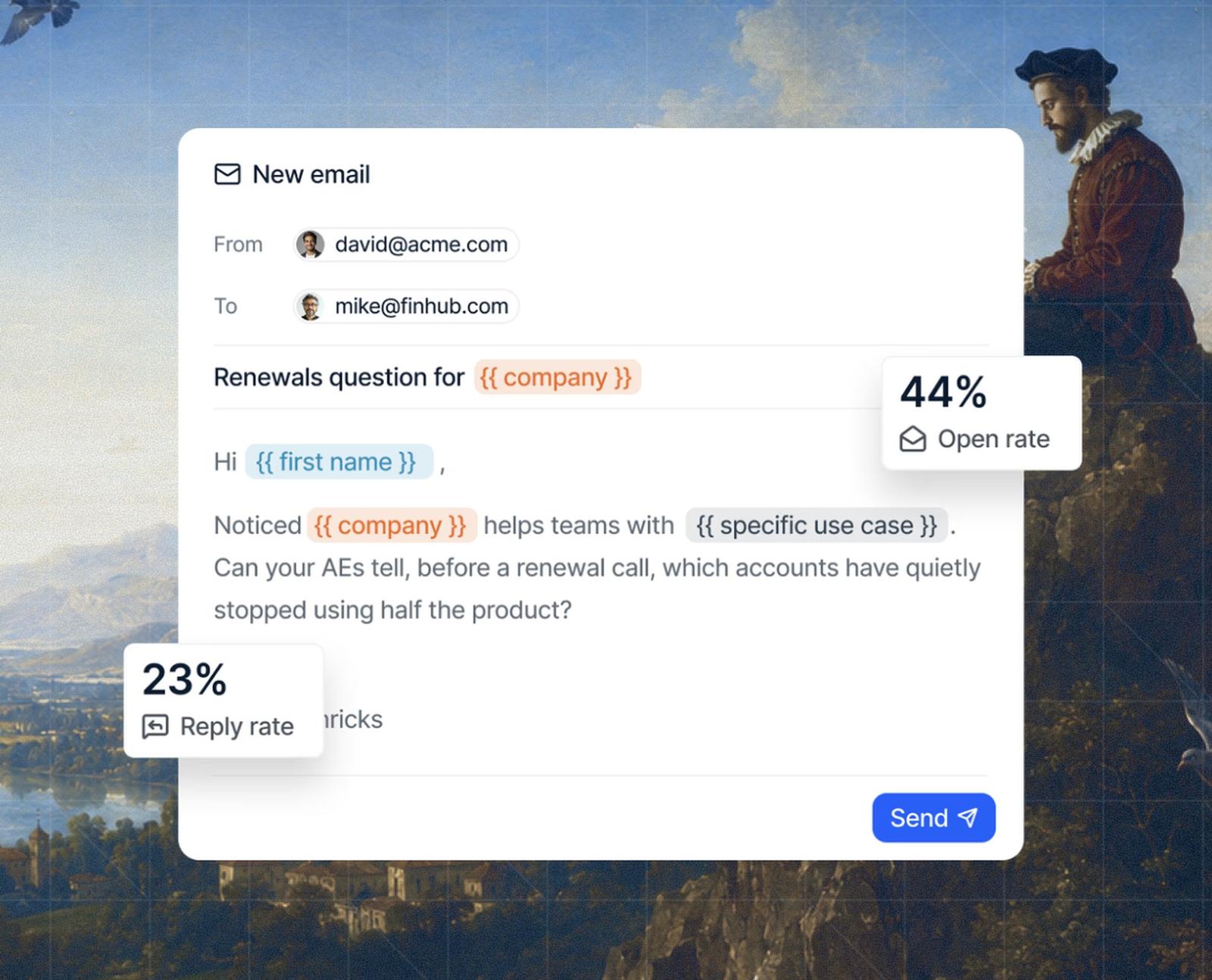
The strategy depends on knowing who to reach. FounderLed combines data from multiple sources to build its audience, then uses each campaign to challenge assumptions about who the buyer actually is.
Reist uses AI for research but keeps the writing human. “A lot of these tools are automating personalization now and it feels very fake and sloppy,” he says. “The two questions I ask myself every time I write copy are: how can I make this more specific, and how can I make it simpler?”
Find the signal, then turn it up
Reist doesn’t assume the first message will be the right one. FounderLed tests different angles against the same audience, looking for the message that gets buyers to respond. When something works, the team expands its reach before moving on to the next idea.
When something works really well, you’ll saturate that audience with that message naturally. You’ll just speed run it, try to get in front of everybody.
That makes repetition deliberate. The goal is to discover what matters to a specific group of buyers, and make sure every one of them hears it.
The learning is the point
The wall of sound does more than build recognition. Every campaign gives Reist a clearer picture of who’s responding, what resonates, and which assumptions deserve a second look.
One client, an AI startup whose most active users were engineers, assumed its enterprise buyer was the CTO. Outreach to engineering leaders went nowhere, while product executives responded almost immediately. The results suggested the company had been targeting the wrong buyer.
But knowing who responds is only the beginning. Reist uses those signals to question the assumptions behind a company’s strategy and test what to do differently. “A lot of times nothing will work, until one thing works. And then when one thing works, we go all in on that thing.”
It’s a distinction that extends well beyond sales. Every company has data showing what’s happening, from pipeline performance to product adoption. The harder question is why.
Reist’s approach is a reminder that the most useful information often comes from the people on the other side of the numbers. Understanding why something works is what gives leaders the confidence to decide what comes next.