Employee Engagement Survey Questions: 65+ Best Examples for March 2026
Employee Engagement Survey Questions: 65+ Best Examples for March 2026

65+ employee engagement survey questions for March 2026. Organized by category to diagnose where employees disconnect and drive real results.
When you run an employee engagement survey, you’re not really measuring happiness. You’re figuring out where people start to disconnect from their work, their manager, or the mission. A satisfied employee might coast, but an engaged one pushes things forward. These 65+ questions are grouped so you can spot real gaps and act on them, and if you want to go deeper, modern tools use AI voice interviews to capture more honest feedback at scale.
TLDR:
Employee engagement surveys show how connected people feel to their work, on top of how satisfied they are.
Frameworks like the Gallup Q12 help you focus on what employees actually need to do their best work.
Combine rating scales with a few open questions, and keep it under 10 minutes to maintain strong response rates.
Move quickly on results, choose three priorities at most, and assign clear owners to each.
Some teams now use AI-led voice interviews to gather feedback at scale, often seeing much higher participation.
What Is an Employee Engagement Survey?
An employee engagement survey looks at how connected people feel to their work and how much they care about what they’re doing. It goes beyond surface-level sentiment and asks about purpose, manager relationships, access to what they need, and whether they’re willing to put in extra effort when it counts.
That’s where engagement and satisfaction start to split. Someone can be satisfied with their pay and still coast. Engagement shows up when people feel tied to the mission and want to contribute in a real way.

Engagement might sit at 73%, up six points from last year, but that number on its own doesn’t tell you much. What matters is what you do with it.
65+ Employee Engagement Survey Questions by Category
Category | What It Measures | Sample Question |
|---|---|---|
Leadership and Trust | Confidence in management decisions and transparency | Do you trust senior leadership to make good decisions? |
Career Development | Growth opportunities and internal mobility | Do you see a clear path for advancement here? |
Company Culture | Belonging, psychological safety, and values alignment | Do you feel psychologically safe speaking up? |
Recognition | How contributions are acknowledged and celebrated | Do you receive recognition when you do good work? |
Work-Life Balance | Workload manageability and boundary respect | Can you disconnect after work hours? |
Remote Work | Distributed team connection and tooling effectiveness | Do you feel connected to your team while remote? |
Enablement | Access to resources and training needed for success | Do you have what you need to do your job well? |
These questions are grouped by what they’re meant to uncover, so you can focus on the areas that matter most.
Leadership and Trust
Do you trust senior leadership to make good decisions for the company?
Does your manager care about your well-being?
How often does your manager provide useful feedback?
Do you feel comfortable sharing concerns with your manager?
Does leadership communicate the company direction clearly?
Do you believe leadership acts on employee feedback?
Does your manager support your growth?
How transparent is leadership about business challenges?
Do you feel heard by your manager?
Does leadership follow through on commitments?
Career Development
Do you see a clear path for advancement here?
Are you learning skills that help your career?
Does your manager discuss your career goals with you?
Do you have access to training you need?
Are internal opportunities communicated clearly?
Do you feel stuck in your current role?
Does the company invest in your development?
Are promotions based on merit?
Do you know what's required to advance?
Can you move into different roles internally?
Company Culture
Do you feel like you belong here?
Are company values reflected in daily work?
Do you feel psychologically safe speaking up?
Is collaboration encouraged and supported?
Do people from different backgrounds feel included?
Does the company live up to its stated mission?
Would you recommend this as a place to work?
Do teams work well together across departments?
Is feedback welcomed or discouraged?
Do you feel proud to work here?
Recognition
Do you receive recognition when you do good work?
Is recognition timely and specific?
Does your manager notice your contributions?
Are achievements celebrated publicly?
Do you feel valued for what you bring?
Is recognition fair across the team?
Does recognition feel genuine?
Are both big wins and small efforts acknowledged?
Do peers recognize each other's work?
Does recognition happen regularly or rarely?
Work-Life Balance
Can you disconnect after work hours?
Do you feel pressure to be always available?
Does your workload feel manageable?
Are deadlines realistic?
Do you have flexibility when personal needs arise?
Does your manager respect your time off?
Are you able to take breaks during the day?
Do you feel burned out?
Can you maintain boundaries?
Does the company respect personal time?
Remote Work Experience
Do you have the tools you need to work remotely?
Do you feel connected to your team while remote?
Is communication clear in a distributed setup?
Do you feel isolated working from home?
Are meetings run effectively in a hybrid model?
Do remote workers have equal opportunities?
Can you collaborate easily with teammates?
Does the company support your home office setup?
Do you prefer remote, hybrid, or in-office work?
Enablement and Resources
Do you have what you need to do your job well?
Is training delivered in a way that works for you?
Can you apply what you learn immediately?
Are resources easy to find when you need them?
Does enablement content feel relevant to your role?
Do you get information when you need it, not months later?
Is learning integrated into your workflow?
Do you know where to go when you need help?
Are onboarding materials clear and actionable?
Does training stick, or do you forget it quickly?
How to Structure an Effective Employee Engagement Survey
Keep your survey under 10 minutes. Many teams aim for 60% to 80% completion rates, depending on company size and culture. If you’re below that, it’s usually a sign the survey is too long, poorly timed, or unclear.
Use a mix of question types so you get both data and context. Rating scales help you spot trends, while open-ended questions give you the “why” behind the numbers.
Group questions by theme so it’s easier to move through. Keep manager-related questions together, culture questions together, and so on.
Watch out for double-barreled questions like “Do you trust your manager and feel supported?” That’s really two questions.
Before rolling it out company-wide, test it with a small group. If anything feels confusing or takes too long, adjust before you send it to everyone.
Understanding the Gallup Q12 Survey Framework
The Gallup Q12 is a set of 12 questions built to measure whether employees have what they need to do their jobs well. More than 25 million employees have answered these questions, which is why it’s one of the most widely used engagement frameworks.
The structure starts with the basics, then moves into team dynamics, and finally growth. It begins with questions like “Do I know what’s expected of me?” and builds up to “In the last six months, has someone talked to me about my progress?”
It focuses on the core drivers of performance: clear expectations, the right resources, recognition, and opportunities to grow. When those are in place, engagement tends to follow.
You don’t have to use the Q12 word for word, but the structure is useful. Start with what people need to do their jobs, then look at connection and growth from there.
How to Analyze Employee Engagement Survey Results
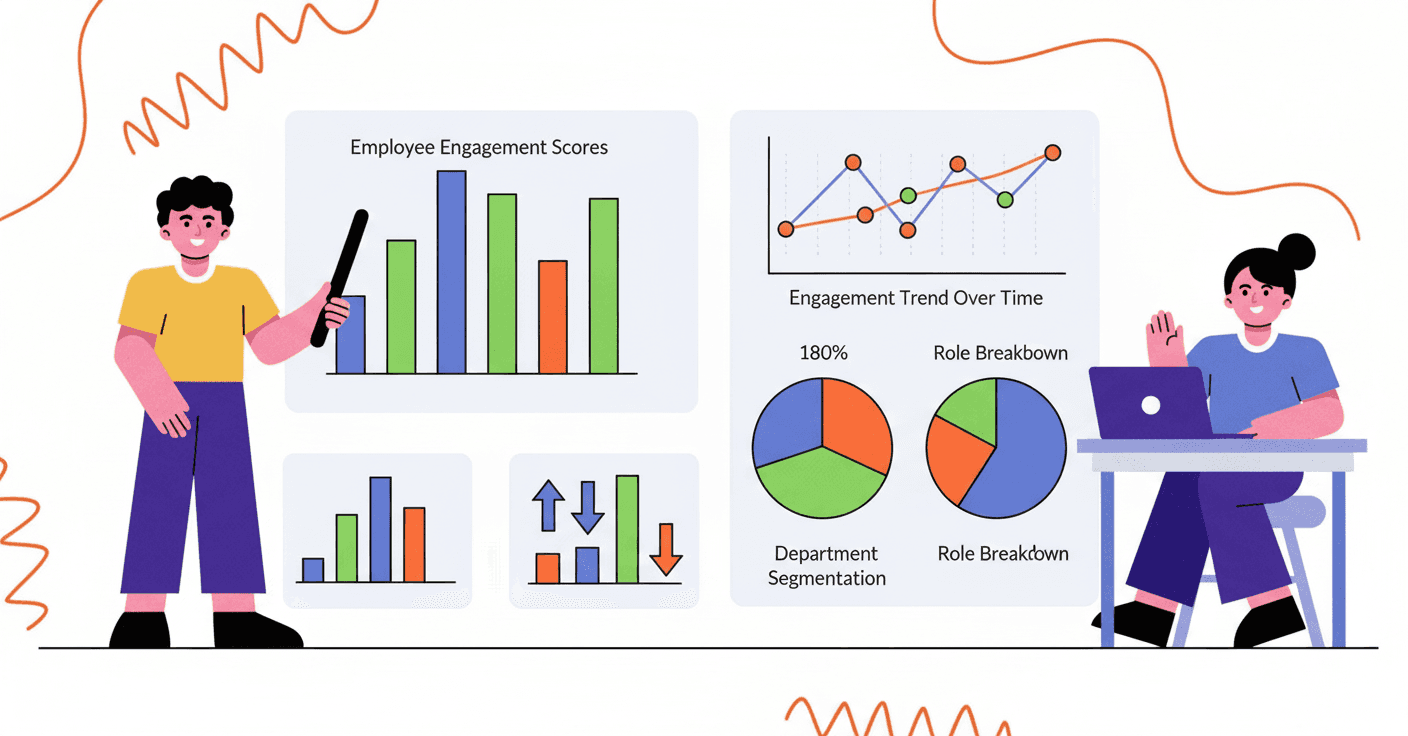
Start with response rates and completion patterns. If certain teams or roles have low participation, it often points to trust issues or survey fatigue.
Look at benchmarks, but don’t get stuck on the number alone. A 70% engagement score doesn’t mean much without context like your industry, company size, or past results.
Pay attention to where scores group together and where they don’t. If enablement is high but recognition is low, that’s a clear signal on where to focus. Break the data down by team, tenure, role, and location to spot patterns.
Next, weigh issues by impact. A manager trust issue affecting 200 people matters more than a smaller concern raised by a handful. Focus on what touches the most people and ties closest to performance.
Then read through open-ended responses. The numbers tell you what’s off. The comments tell you why and what to do next.
Employee Engagement Survey Benchmarks and What They Mean
Benchmarks help you make sense of your scores. A 65% engagement rate might be strong in one industry and weak in another.
Three comparisons matter most: industry, company size, and region. Engagement in manufacturing tends to be lower than in professional services. A company with 10,000 employees will see different patterns than one with 500.
In many internal survey models, higher-performing teams tend to score well above their own historical averages. Above that, you’re in a good spot. Lower scores compared to your past results usually point to gaps, while mid-range scores often indicate room to improve.
What matters most is your trend over time. If you’ve moved from 62% to 68%, that’s real progress. If you’ve dropped from 78% to 72%, something needs attention.
Turning Survey Results into Action Plans
Start by narrowing your focus. Pick three problems at most. Trying to fix everything at once spreads your efforts too thin. Choose issues that affect the most people and tie directly to outcomes like retention, performance, or revenue.
Build a clear case for each one. Then assign ownership and timelines. Clear ownership and deadlines create momentum. Finally, communicate early. Share what you’re working on before people have to ask. Be clear about what’s changing and honest about what isn’t.
Using AI to Rebuild Employee Engagement Survey Workflows
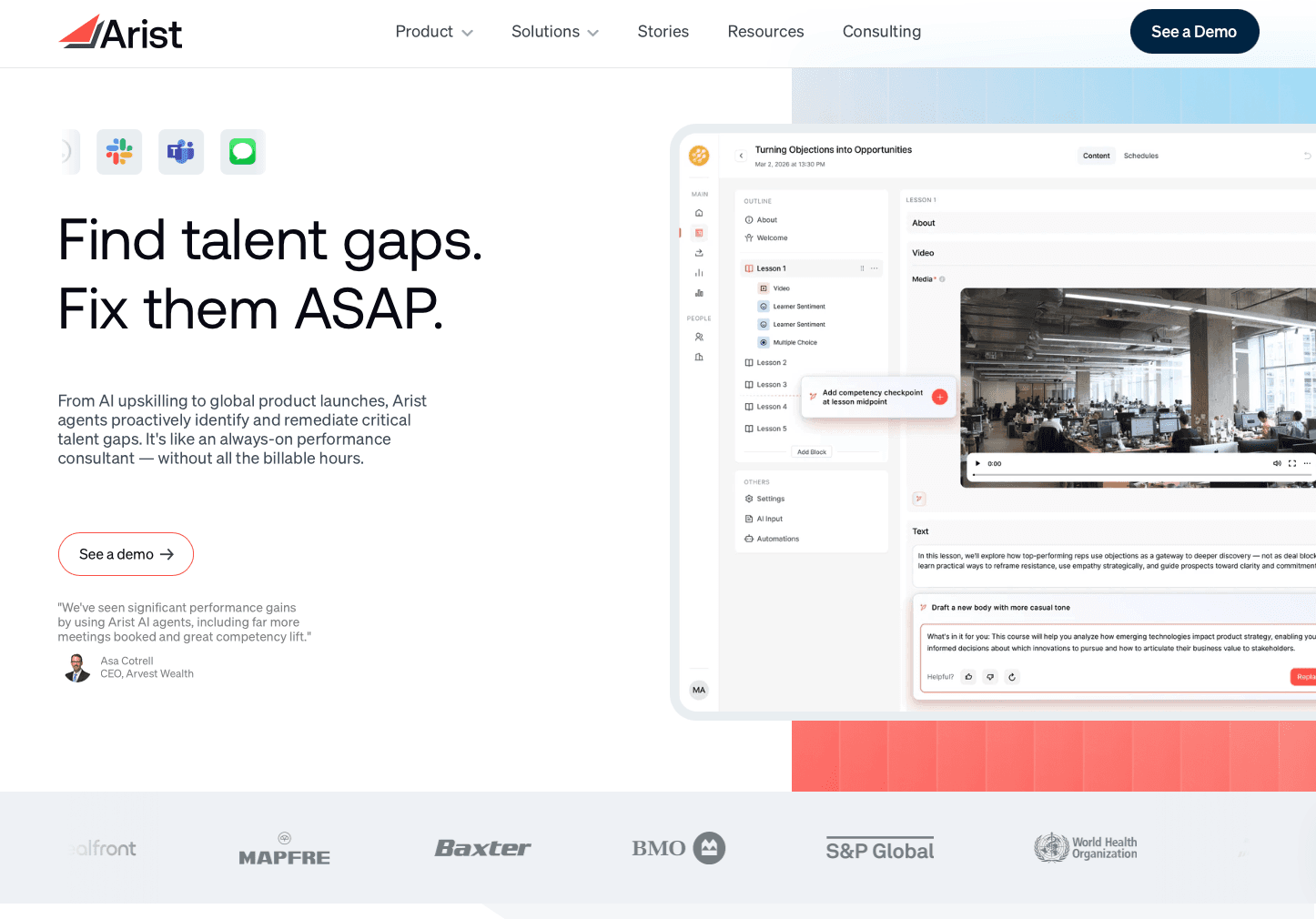
Some teams are starting to move beyond traditional surveys and use AI voice interviews to gather feedback in a more natural way.
With Arist, employees respond through short, conversational interviews instead of static forms. It feels more like a real conversation, which leads to more honest input and often drives up to 3x higher participation.
Behind the scenes, Arist analyzes responses alongside internal data to spot patterns quickly. Instead of waiting weeks to sort through results, you can see where engagement is breaking down and what to do about it.
From there, Arist helps close the loop. It can deliver targeted follow-ups through tools like Teams, Slack, or SMS, so employees get support in the flow of their day.
The process becomes continuous: listen, understand what’s not working, take action, and keep improving over time.
FAQs
How long should an employee engagement survey take to complete?
Keep it under 10 minutes. That’s often the sweet spot for maintaining strong response rates. Once surveys get longer, completion drops and the quality of responses tends to dip.
How often should you survey employees about engagement?
A good rhythm is one annual survey for a full snapshot, paired with quarterly pulse surveys that focus on a few key areas. This helps you catch issues early without overwhelming people.
What should you do immediately after collecting survey results?
Start by sharing what you learned. Then narrow your focus to three key issues, assign clear owners, and set timelines. If people don’t see anything change after giving feedback, they’re much less likely to participate next time.
Final Thoughts on Employee Engagement Surveys
Most employee engagement survey results end up in a slide deck that gets reviewed once and then ignored. The teams that get real value do something different. They share what they learned, what’s changing, and what isn’t within a couple of weeks. They pick three clear problems, assign owners, and show progress before the next survey goes out. That’s also where tools like Arist can help. At the end of the day, your employee engagement survey is only as useful as what happens after it. Participation rates will tell you quickly whether people believe anything will come from it.
When you run an employee engagement survey, you’re not really measuring happiness. You’re figuring out where people start to disconnect from their work, their manager, or the mission. A satisfied employee might coast, but an engaged one pushes things forward. These 65+ questions are grouped so you can spot real gaps and act on them, and if you want to go deeper, modern tools use AI voice interviews to capture more honest feedback at scale.
TLDR:
Employee engagement surveys show how connected people feel to their work, on top of how satisfied they are.
Frameworks like the Gallup Q12 help you focus on what employees actually need to do their best work.
Combine rating scales with a few open questions, and keep it under 10 minutes to maintain strong response rates.
Move quickly on results, choose three priorities at most, and assign clear owners to each.
Some teams now use AI-led voice interviews to gather feedback at scale, often seeing much higher participation.
What Is an Employee Engagement Survey?
An employee engagement survey looks at how connected people feel to their work and how much they care about what they’re doing. It goes beyond surface-level sentiment and asks about purpose, manager relationships, access to what they need, and whether they’re willing to put in extra effort when it counts.
That’s where engagement and satisfaction start to split. Someone can be satisfied with their pay and still coast. Engagement shows up when people feel tied to the mission and want to contribute in a real way.
Engagement might sit at 73%, up six points from last year, but that number on its own doesn’t tell you much. What matters is what you do with it.
65+ Employee Engagement Survey Questions by Category
Category | What It Measures | Sample Question |
|---|---|---|
Leadership and Trust | Confidence in management decisions and transparency | Do you trust senior leadership to make good decisions? |
Career Development | Growth opportunities and internal mobility | Do you see a clear path for advancement here? |
Company Culture | Belonging, psychological safety, and values alignment | Do you feel psychologically safe speaking up? |
Recognition | How contributions are acknowledged and celebrated | Do you receive recognition when you do good work? |
Work-Life Balance | Workload manageability and boundary respect | Can you disconnect after work hours? |
Remote Work | Distributed team connection and tooling effectiveness | Do you feel connected to your team while remote? |
Enablement | Access to resources and training needed for success | Do you have what you need to do your job well? |
These questions are grouped by what they’re meant to uncover, so you can focus on the areas that matter most.
Leadership and Trust
Do you trust senior leadership to make good decisions for the company?
Does your manager care about your well-being?
How often does your manager provide useful feedback?
Do you feel comfortable sharing concerns with your manager?
Does leadership communicate the company direction clearly?
Do you believe leadership acts on employee feedback?
Does your manager support your growth?
How transparent is leadership about business challenges?
Do you feel heard by your manager?
Does leadership follow through on commitments?
Career Development
Do you see a clear path for advancement here?
Are you learning skills that help your career?
Does your manager discuss your career goals with you?
Do you have access to training you need?
Are internal opportunities communicated clearly?
Do you feel stuck in your current role?
Does the company invest in your development?
Are promotions based on merit?
Do you know what's required to advance?
Can you move into different roles internally?
Company Culture
Do you feel like you belong here?
Are company values reflected in daily work?
Do you feel psychologically safe speaking up?
Is collaboration encouraged and supported?
Do people from different backgrounds feel included?
Does the company live up to its stated mission?
Would you recommend this as a place to work?
Do teams work well together across departments?
Is feedback welcomed or discouraged?
Do you feel proud to work here?
Recognition
Do you receive recognition when you do good work?
Is recognition timely and specific?
Does your manager notice your contributions?
Are achievements celebrated publicly?
Do you feel valued for what you bring?
Is recognition fair across the team?
Does recognition feel genuine?
Are both big wins and small efforts acknowledged?
Do peers recognize each other's work?
Does recognition happen regularly or rarely?
Work-Life Balance
Can you disconnect after work hours?
Do you feel pressure to be always available?
Does your workload feel manageable?
Are deadlines realistic?
Do you have flexibility when personal needs arise?
Does your manager respect your time off?
Are you able to take breaks during the day?
Do you feel burned out?
Can you maintain boundaries?
Does the company respect personal time?
Remote Work Experience
Do you have the tools you need to work remotely?
Do you feel connected to your team while remote?
Is communication clear in a distributed setup?
Do you feel isolated working from home?
Are meetings run effectively in a hybrid model?
Do remote workers have equal opportunities?
Can you collaborate easily with teammates?
Does the company support your home office setup?
Do you prefer remote, hybrid, or in-office work?
Enablement and Resources
Do you have what you need to do your job well?
Is training delivered in a way that works for you?
Can you apply what you learn immediately?
Are resources easy to find when you need them?
Does enablement content feel relevant to your role?
Do you get information when you need it, not months later?
Is learning integrated into your workflow?
Do you know where to go when you need help?
Are onboarding materials clear and actionable?
Does training stick, or do you forget it quickly?
How to Structure an Effective Employee Engagement Survey
Keep your survey under 10 minutes. Many teams aim for 60% to 80% completion rates, depending on company size and culture. If you’re below that, it’s usually a sign the survey is too long, poorly timed, or unclear.
Use a mix of question types so you get both data and context. Rating scales help you spot trends, while open-ended questions give you the “why” behind the numbers.
Group questions by theme so it’s easier to move through. Keep manager-related questions together, culture questions together, and so on.
Watch out for double-barreled questions like “Do you trust your manager and feel supported?” That’s really two questions.
Before rolling it out company-wide, test it with a small group. If anything feels confusing or takes too long, adjust before you send it to everyone.
Understanding the Gallup Q12 Survey Framework
The Gallup Q12 is a set of 12 questions built to measure whether employees have what they need to do their jobs well. More than 25 million employees have answered these questions, which is why it’s one of the most widely used engagement frameworks.
The structure starts with the basics, then moves into team dynamics, and finally growth. It begins with questions like “Do I know what’s expected of me?” and builds up to “In the last six months, has someone talked to me about my progress?”
It focuses on the core drivers of performance: clear expectations, the right resources, recognition, and opportunities to grow. When those are in place, engagement tends to follow.
You don’t have to use the Q12 word for word, but the structure is useful. Start with what people need to do their jobs, then look at connection and growth from there.
How to Analyze Employee Engagement Survey Results
Start with response rates and completion patterns. If certain teams or roles have low participation, it often points to trust issues or survey fatigue.
Look at benchmarks, but don’t get stuck on the number alone. A 70% engagement score doesn’t mean much without context like your industry, company size, or past results.
Pay attention to where scores group together and where they don’t. If enablement is high but recognition is low, that’s a clear signal on where to focus. Break the data down by team, tenure, role, and location to spot patterns.
Next, weigh issues by impact. A manager trust issue affecting 200 people matters more than a smaller concern raised by a handful. Focus on what touches the most people and ties closest to performance.
Then read through open-ended responses. The numbers tell you what’s off. The comments tell you why and what to do next.
Employee Engagement Survey Benchmarks and What They Mean
Benchmarks help you make sense of your scores. A 65% engagement rate might be strong in one industry and weak in another.
Three comparisons matter most: industry, company size, and region. Engagement in manufacturing tends to be lower than in professional services. A company with 10,000 employees will see different patterns than one with 500.
In many internal survey models, higher-performing teams tend to score well above their own historical averages. Above that, you’re in a good spot. Lower scores compared to your past results usually point to gaps, while mid-range scores often indicate room to improve.
What matters most is your trend over time. If you’ve moved from 62% to 68%, that’s real progress. If you’ve dropped from 78% to 72%, something needs attention.
Turning Survey Results into Action Plans
Start by narrowing your focus. Pick three problems at most. Trying to fix everything at once spreads your efforts too thin. Choose issues that affect the most people and tie directly to outcomes like retention, performance, or revenue.
Build a clear case for each one. Then assign ownership and timelines. Clear ownership and deadlines create momentum. Finally, communicate early. Share what you’re working on before people have to ask. Be clear about what’s changing and honest about what isn’t.
Using AI to Rebuild Employee Engagement Survey Workflows
Some teams are starting to move beyond traditional surveys and use AI voice interviews to gather feedback in a more natural way.
With Arist, employees respond through short, conversational interviews instead of static forms. It feels more like a real conversation, which leads to more honest input and often drives up to 3x higher participation.
Behind the scenes, Arist analyzes responses alongside internal data to spot patterns quickly. Instead of waiting weeks to sort through results, you can see where engagement is breaking down and what to do about it.
From there, Arist helps close the loop. It can deliver targeted follow-ups through tools like Teams, Slack, or SMS, so employees get support in the flow of their day.
The process becomes continuous: listen, understand what’s not working, take action, and keep improving over time.
FAQs
How long should an employee engagement survey take to complete?
Keep it under 10 minutes. That’s often the sweet spot for maintaining strong response rates. Once surveys get longer, completion drops and the quality of responses tends to dip.
How often should you survey employees about engagement?
A good rhythm is one annual survey for a full snapshot, paired with quarterly pulse surveys that focus on a few key areas. This helps you catch issues early without overwhelming people.
What should you do immediately after collecting survey results?
Start by sharing what you learned. Then narrow your focus to three key issues, assign clear owners, and set timelines. If people don’t see anything change after giving feedback, they’re much less likely to participate next time.
Final Thoughts on Employee Engagement Surveys
Most employee engagement survey results end up in a slide deck that gets reviewed once and then ignored. The teams that get real value do something different. They share what they learned, what’s changing, and what isn’t within a couple of weeks. They pick three clear problems, assign owners, and show progress before the next survey goes out. That’s also where tools like Arist can help. At the end of the day, your employee engagement survey is only as useful as what happens after it. Participation rates will tell you quickly whether people believe anything will come from it.
Related Resources

Article
AI Upskilling: A Practical Guide for Building Your Team in June 2026
Learn how to build AI upskilling programs that drive behavior change. Practical guide with frameworks, metrics, and proven strategies for June 2026.
Read more
Article
Salesforce Training for Beginners: Complete June 2026 Guide
Complete Salesforce training for beginners in June 2026. Learn Trailhead, certifications, admin paths, and career options with this full overview.
Read more
Bring real impact to your people
We care about solving meaningful problems and being thought partners first and foremost. Arist is used and loved by the Fortune 500 — and we'd love to support your goals.
Curious to get a demo or free trial? We'd love to chat:

Bring real impact to your people
We care about solving meaningful problems and being thought partners first and foremost. Arist is used and loved by the Fortune 500 — and we'd love to support your goals.
Curious to get a demo or free trial? We'd love to chat:
Bring real impact to your people
We care about solving meaningful problems and being thought partners first and foremost. Arist is used and loved by the Fortune 500 — and we'd love to support your goals.
Curious to get a demo or free trial? We'd love to chat: