How to Use Sales Enablement to Improve Performance and Boost ROI in February 2026
How to Use Sales Enablement to Improve Performance and Boost ROI in February 2026
Learn how to use sales enablement to improve performance and boost ROI in February 2026. Proven tactics to increase win rates, quota attainment, and revenue.
Sales enablement sounds great in theory until you realize your team still is not hitting quota. You built the content, scheduled the training sessions, and uploaded everything to your LMS, yet when a competitor comes up on a live call your reps are still guessing. The issue is not effort, it is timing, access, and reinforcement. Most programs sit in portals reps rarely open and fade from memory before they influence a deal. Real results from sales enablement to improve performance happen when learning shows up inside the tools reps already use and connects directly to active opportunities, which is the model this solution is built to support.
TLDR:
Sales enablement delivered in daily tools sees completion rates rise dramatically compared to traditional LMS portals, where employees typically check in only once every six weeks.
Teams with strong enablement see 49% win rates compared to 42.5% without structured programs.
AI-powered enablement cuts content creation from weeks to hours while personalizing by role.
Continuous reinforcement reduces knowledge decay, increasing message retention and in-call execution when it matters most.
Some modern solutions deliver training through SMS, Teams, and Slack with automated content generation and revenue analytics.
What Sales Enablement Is and Why It Drives Performance
Sales enablement is the ongoing system that equips your sales team with the right content, tools, coaching, and processes when they need them most. It keeps reps prepared to handle every stage of the buyer journey.
The impact is measurable. Teams with strong enablement achieve higher win rates, better quota attainment, and faster ramp times. Roughly 88% of sales leaders see sales enablement as critical to driving sales results.
The real challenge is execution. Sales enablement only improves performance when it's woven into daily workflows, tailored to each role, and reinforced continuously. Without that structure, content goes unused and coaching fails to drive revenue.
Sales reps must now practice multi-threading, building relationships with multiple contacts at different organizational levels, as buying committees average 10+ stakeholders, with enterprise deals involving 20+ decision-makers across IT, finance, legal, and department heads.
The Performance Gap: Why Traditional Sales Training Falls Short
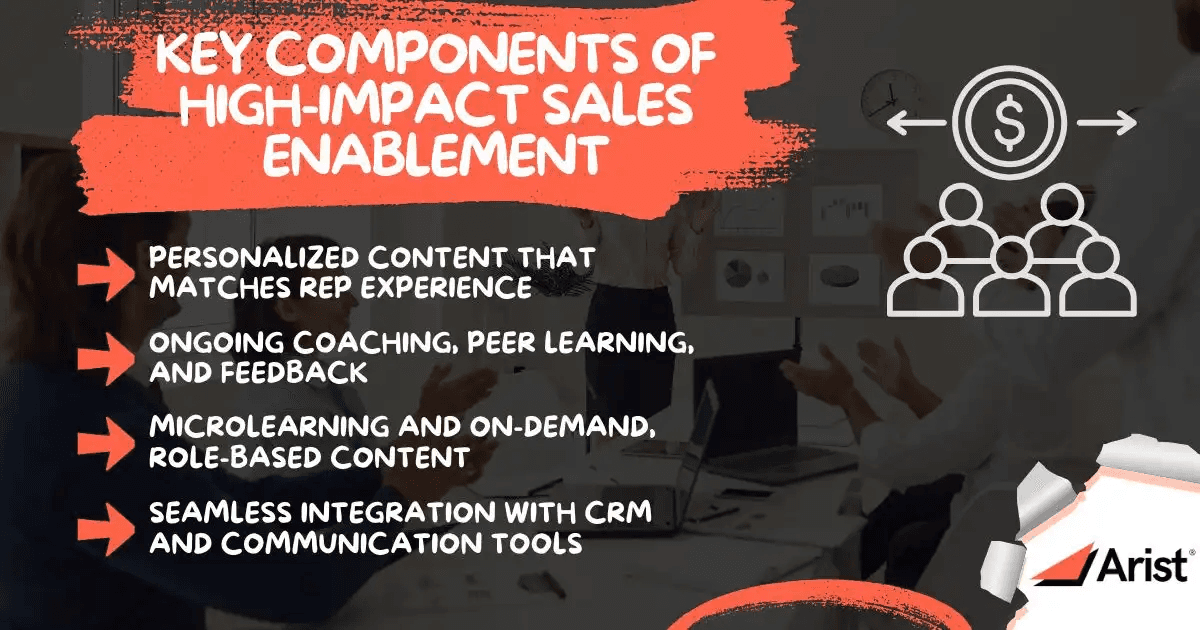
Most sales reps are set up to miss their targets. Only 30% expect to hit 100% of their quota, with another 34% hoping to land somewhere between 76% and 99%. The gap isn't about effort or talent. It's about how information reaches them.
Traditional training treats learning as an event. Reps sit through a one-day session, absorb a flood of information, then return to their territory. Within weeks, most of that knowledge disappears. They're left scrambling through slide decks and email threads when a prospect asks a tough question.
The average B2B SaaS sales cycle has stretched to 134 days, up from 107 days in previous periods, creating more opportunities for deals to stall and making continuous reinforcement even more critical.
Without reinforcement, reps quickly forget what they learn. Sales enablement keeps skills sharp through ongoing reinforcement delivered in the tools reps use daily.
The ROI of Strategic Sales Enablement Programs
Sales enablement delivers measurable returns. Sales training produces a 453% average ROI, generating $4.53 per dollar spent through direct revenue gains.
The performance gap between enabled and unenabled teams is clear. Organizations with enablement programs achieve 49% win rates versus 42.5% without them. That 6.5-point difference can translate to substantial revenue increases.
Three factors drive these returns: faster sales cycles, larger deal values, and improved quota attainment. Reps with quick access to the right content close deals faster. Those who understand positioning and competitive differentiation sell more while discounting less.
Performance Metric | With Strong Enablement | Without Structured Programs | Impact on Revenue |
|---|---|---|---|
Win Rate | 49% | 42.5% | 6.5 percentage point increase translates to substantially more closed deals from the same pipeline |
Average ROI from Training | 453% return | Inconsistent or unmeasured ROI | $4.53 generated per dollar spent on sales training and enablement initiatives |
Quota Attainment (100%+) | Higher achievement rates with continuous reinforcement | Less than 30% of reps expect to hit 100% quota | Direct correlation between enablement engagement and quota achievement by cohort |
Completion Rate | 95% when delivered in daily tools (SMS, Teams, Slack) | 30% or less for traditional LMS portals | Higher engagement means skills are actually applied in live selling situations |
Knowledge Retention | Maintained through spaced repetition and continuous reinforcement | Rapid decay within weeks of one-time training events | Reps execute learned strategies during critical deal moments instead of guessing |
Time to Productivity (New Hires) | Reduced ramp time with structured onboarding in the flow of work | Extended learning curves with traditional training approaches | Lower cost per new rep and faster contribution to revenue targets |
Key Performance Metrics to Track Sales Enablement Success
The metrics you track determine whether you can prove enablement value or simply hope it's working. Most sales enablement teams struggle to connect their efforts to revenue outcomes because they measure activity instead of results.
Start with quota attainment by cohort. Compare reps who completed enablement against those who didn't. Track win rates, average deal size, and sales cycle length across both groups. The difference shows real impact.
Ramp time matters for new hires. Effective enablement reduces time to productivity and lowers the cost of each new rep.
Track content usage and engagement separately from outcomes. High completion rates mean nothing if quota attainment doesn't improve. Link training engagement to downstream revenue metrics to prove what actually works.
Building a Continuous Learning System That Sticks
One-time training events don't create lasting behavior change. Continuous learning does. The shift requires embedding enablement into the sales workflow instead of pulling reps away from it.
Reps need information when a deal stalls or a competitor surfaces, not two weeks later during a scheduled training session. Delivering short, relevant reinforcement through Teams, Slack, or SMS meets reps where they work. Only 37% of sales reps use CRMs to their full potential, indicating a considerable training gap that integrated workflow training can tackle.
Spaced repetition builds retention through short refreshers delivered over time without disrupting selling. Reps forget 70% of new information within 24 hours without reinforcement, making continuous learning critical for retaining skills when they matter most during live calls.
Coaching amplifies what training starts. Teams with formal coaching programs see 28% higher win rates, with coaching also boosting deal size and pipeline by 25-40%, showing how manager-led reinforcement amplifies enablement results.
Personalizing Enablement by Role and Experience Level
Generic enablement wastes time and money. A new hire needs different content than a veteran closing seven-figure deals. Role and tenure should influence what reps learn and when.
New hires need foundational knowledge: product positioning, buyer personas, sales methodology, and basic objection handling. The goal is shortening time to first deal. Deliver this content in daily bursts during their first 30 to 60 days, reinforcing core concepts before they take live calls.
Mid-level and top performers need targeted development such as competitive intelligence, advanced objection handling, strategic account planning, and executive-level selling skills aligned to identified performance gaps.
Integrating Enablement into Sales Workflows
Enablement that requires extra steps gets ignored. When reps need to log into a separate LMS, search through file folders, or attend scheduled sessions, they skip it. Employees typically check traditional LMS systems only once every six weeks, accentuating the engagement gap that separate portals create. The best enablement meets reps inside the tools they use every day.
Integration into CRM, Teams, Slack, and messaging apps removes friction. A rep preparing for a call can access competitive battle cards directly in Salesforce. A manager can send reinforcement through a quick Teams message. No context switching, no hunting for links.
Arist delivers training through SMS, WhatsApp, Teams, and Slack because that's where work happens. Reps receive a 60-second lesson between meetings or a quick quiz before a customer call. Completion rates rise dramatically when lessons are delivered in the flow of work compared to traditional LMS engagement. Bite-sized training courses achieve 80% completion rates versus 20% for traditional training modules, showing the engagement advantage of short-form learning formats delivered in workflow tools. The ROI difference is simple: content that's used drives revenue, content that sits in a portal doesn't.
Measuring and Proving Enablement Impact to Leadership
Leadership cares about revenue, not training completion rates. To prove enablement impact, connect every initiative to a business outcome they track: quota attainment, win rates, or pipeline value.
Start by creating baseline metrics before launching new enablement. Measure current win rates, average deal size, and ramp time for new hires. After implementation, compare the same cohorts. The difference is your proof.
Present findings in their language. Instead of "85% completion rate," say "teams using this enablement closed 12% more deals." Frame results around dollars saved or revenue gained, not engagement scores.
How AI Is Changing Sales Enablement at Scale
AI removes the bottlenecks that limit enablement scale. Content creation that once took weeks now happens in hours. Personalized learning paths adjust in real time based on rep performance. Analytics surface insights without manual reporting.
68% of sales leaders plan to increase investment in AI and automation tools in 2026, and the reason is clear: teams with integrated tech stacks see 24% higher productivity. AI handles repetitive work so enablement teams can focus on strategy and coaching.
The shift goes beyond speed. AI analyzes thousands of conversations to identify common objections, then generates targeted training to manage them. It personalizes reinforcement based on role, deal stage, and knowledge gaps. Small enablement teams can now support thousands of reps without sacrificing quality or relevance.
How Arist Supports Sales Teams to Perform at Their Peak
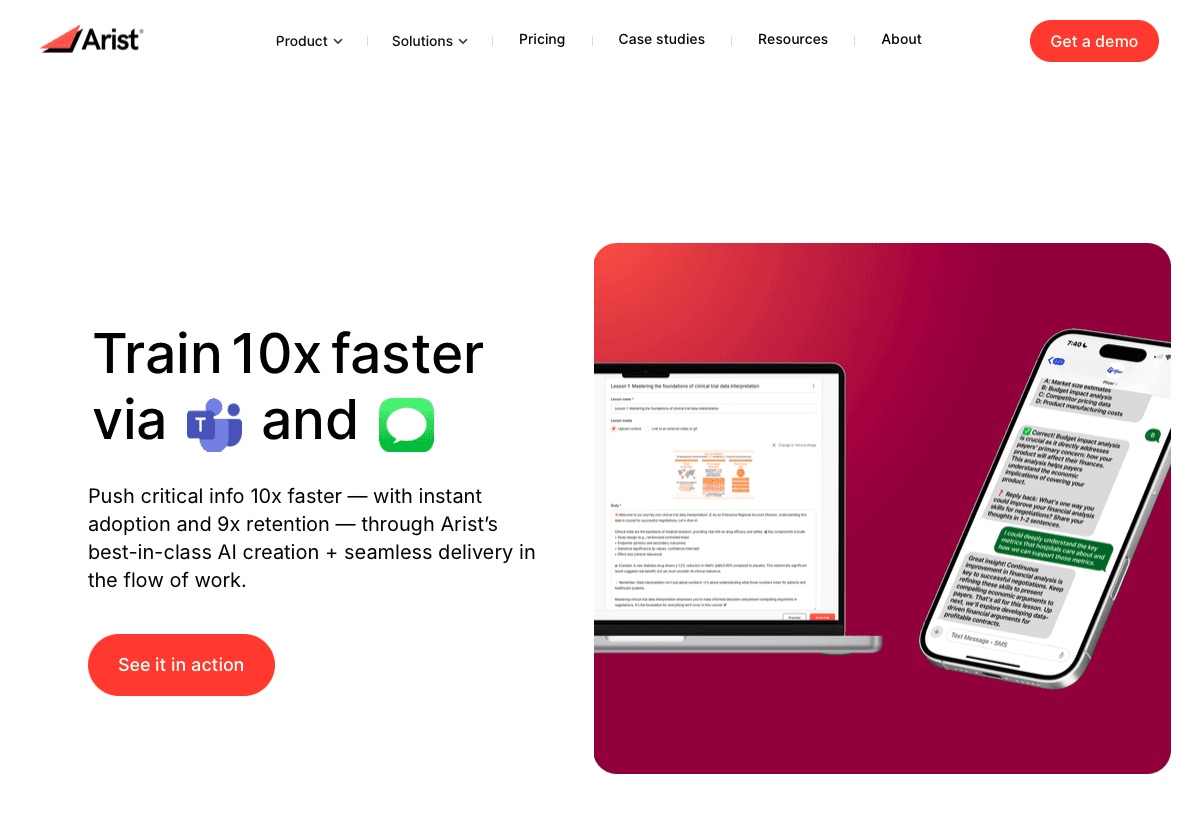
Arist automates the full enablement cycle: AI interviews identify skill gaps, role-specific content generates in minutes, delivery happens through SMS, Teams, Slack, or WhatsApp, and analytics track revenue impact.
Reps get 60-second refreshers between calls without separate logins or portals. Completion rates regularly exceed 95%.
The Creator Agent builds personalized learning paths by role and experience level, generating multiple content formats including courses, quizzes, surveys, videos, podcasts, and job aids, reducing training content development time from weeks to hours. New hires receive foundational training while veterans get advanced deal strategy. The Routing Agent delivers reinforcement based on behavior and performance data.
The Analytics Agent allows users to query data in plain English (e.g., "Which interventions improved manager performance last quarter?") and automatically connects training to business KPIs like revenue impact, time to productivity, deal win rates, quota attainment, and pipeline velocity, providing clear ROI proof.
Companies like Novo Nordisk and Eli Lilly use Arist to train thousands of reps across global markets in days.
FAQs
What's the difference between sales training and sales enablement?
Sales training is a one-time event where reps learn new information, while sales enablement is an ongoing system that delivers the right content, coaching, and tools throughout the entire sales cycle when reps need them most.
When should I switch from scheduled training sessions to continuous reinforcement?
If your reps forget material within weeks of training or if completion rates for scheduled sessions fall below 70%, it's time to move to a continuous model that delivers short reinforcement through the channels your team already uses daily.
What metrics prove sales enablement impact to executive leadership?
Focus on quota attainment by cohort, win rate improvements, average deal size changes, and sales cycle length reductions. These revenue-linked metrics matter more to executives than training completion rates or engagement scores.
Final Thoughts on Boosting Performance through Sales Enablement
Your sales team cannot afford to dig through portals or revisit slide decks when a live deal is on the line. Sales enablement to improve performance only works when learning appears in the flow of work, reinforces critical skills in minutes, and ties directly to revenue outcomes like win rates and quota attainment. Arist brings this approach to life by delivering short, targeted training in the tools reps already use while connecting engagement to real performance data. If you are ready to make sales enablement to improve performance a measurable growth driver, see how Arist can help.
Sales enablement sounds great in theory until you realize your team still is not hitting quota. You built the content, scheduled the training sessions, and uploaded everything to your LMS, yet when a competitor comes up on a live call your reps are still guessing. The issue is not effort, it is timing, access, and reinforcement. Most programs sit in portals reps rarely open and fade from memory before they influence a deal. Real results from sales enablement to improve performance happen when learning shows up inside the tools reps already use and connects directly to active opportunities, which is the model this solution is built to support.
TLDR:
Sales enablement delivered in daily tools sees completion rates rise dramatically compared to traditional LMS portals, where employees typically check in only once every six weeks.
Teams with strong enablement see 49% win rates compared to 42.5% without structured programs.
AI-powered enablement cuts content creation from weeks to hours while personalizing by role.
Continuous reinforcement reduces knowledge decay, increasing message retention and in-call execution when it matters most.
Some modern solutions deliver training through SMS, Teams, and Slack with automated content generation and revenue analytics.
What Sales Enablement Is and Why It Drives Performance
Sales enablement is the ongoing system that equips your sales team with the right content, tools, coaching, and processes when they need them most. It keeps reps prepared to handle every stage of the buyer journey.
The impact is measurable. Teams with strong enablement achieve higher win rates, better quota attainment, and faster ramp times. Roughly 88% of sales leaders see sales enablement as critical to driving sales results.
The real challenge is execution. Sales enablement only improves performance when it's woven into daily workflows, tailored to each role, and reinforced continuously. Without that structure, content goes unused and coaching fails to drive revenue.
Sales reps must now practice multi-threading, building relationships with multiple contacts at different organizational levels, as buying committees average 10+ stakeholders, with enterprise deals involving 20+ decision-makers across IT, finance, legal, and department heads.
The Performance Gap: Why Traditional Sales Training Falls Short
Most sales reps are set up to miss their targets. Only 30% expect to hit 100% of their quota, with another 34% hoping to land somewhere between 76% and 99%. The gap isn't about effort or talent. It's about how information reaches them.
Traditional training treats learning as an event. Reps sit through a one-day session, absorb a flood of information, then return to their territory. Within weeks, most of that knowledge disappears. They're left scrambling through slide decks and email threads when a prospect asks a tough question.
The average B2B SaaS sales cycle has stretched to 134 days, up from 107 days in previous periods, creating more opportunities for deals to stall and making continuous reinforcement even more critical.
Without reinforcement, reps quickly forget what they learn. Sales enablement keeps skills sharp through ongoing reinforcement delivered in the tools reps use daily.
The ROI of Strategic Sales Enablement Programs
Sales enablement delivers measurable returns. Sales training produces a 453% average ROI, generating $4.53 per dollar spent through direct revenue gains.
The performance gap between enabled and unenabled teams is clear. Organizations with enablement programs achieve 49% win rates versus 42.5% without them. That 6.5-point difference can translate to substantial revenue increases.
Three factors drive these returns: faster sales cycles, larger deal values, and improved quota attainment. Reps with quick access to the right content close deals faster. Those who understand positioning and competitive differentiation sell more while discounting less.
Performance Metric | With Strong Enablement | Without Structured Programs | Impact on Revenue |
|---|---|---|---|
Win Rate | 49% | 42.5% | 6.5 percentage point increase translates to substantially more closed deals from the same pipeline |
Average ROI from Training | 453% return | Inconsistent or unmeasured ROI | $4.53 generated per dollar spent on sales training and enablement initiatives |
Quota Attainment (100%+) | Higher achievement rates with continuous reinforcement | Less than 30% of reps expect to hit 100% quota | Direct correlation between enablement engagement and quota achievement by cohort |
Completion Rate | 95% when delivered in daily tools (SMS, Teams, Slack) | 30% or less for traditional LMS portals | Higher engagement means skills are actually applied in live selling situations |
Knowledge Retention | Maintained through spaced repetition and continuous reinforcement | Rapid decay within weeks of one-time training events | Reps execute learned strategies during critical deal moments instead of guessing |
Time to Productivity (New Hires) | Reduced ramp time with structured onboarding in the flow of work | Extended learning curves with traditional training approaches | Lower cost per new rep and faster contribution to revenue targets |
Key Performance Metrics to Track Sales Enablement Success
The metrics you track determine whether you can prove enablement value or simply hope it's working. Most sales enablement teams struggle to connect their efforts to revenue outcomes because they measure activity instead of results.
Start with quota attainment by cohort. Compare reps who completed enablement against those who didn't. Track win rates, average deal size, and sales cycle length across both groups. The difference shows real impact.
Ramp time matters for new hires. Effective enablement reduces time to productivity and lowers the cost of each new rep.
Track content usage and engagement separately from outcomes. High completion rates mean nothing if quota attainment doesn't improve. Link training engagement to downstream revenue metrics to prove what actually works.
Building a Continuous Learning System That Sticks
One-time training events don't create lasting behavior change. Continuous learning does. The shift requires embedding enablement into the sales workflow instead of pulling reps away from it.
Reps need information when a deal stalls or a competitor surfaces, not two weeks later during a scheduled training session. Delivering short, relevant reinforcement through Teams, Slack, or SMS meets reps where they work. Only 37% of sales reps use CRMs to their full potential, indicating a considerable training gap that integrated workflow training can tackle.
Spaced repetition builds retention through short refreshers delivered over time without disrupting selling. Reps forget 70% of new information within 24 hours without reinforcement, making continuous learning critical for retaining skills when they matter most during live calls.
Coaching amplifies what training starts. Teams with formal coaching programs see 28% higher win rates, with coaching also boosting deal size and pipeline by 25-40%, showing how manager-led reinforcement amplifies enablement results.
Personalizing Enablement by Role and Experience Level
Generic enablement wastes time and money. A new hire needs different content than a veteran closing seven-figure deals. Role and tenure should influence what reps learn and when.
New hires need foundational knowledge: product positioning, buyer personas, sales methodology, and basic objection handling. The goal is shortening time to first deal. Deliver this content in daily bursts during their first 30 to 60 days, reinforcing core concepts before they take live calls.
Mid-level and top performers need targeted development such as competitive intelligence, advanced objection handling, strategic account planning, and executive-level selling skills aligned to identified performance gaps.
Integrating Enablement into Sales Workflows
Enablement that requires extra steps gets ignored. When reps need to log into a separate LMS, search through file folders, or attend scheduled sessions, they skip it. Employees typically check traditional LMS systems only once every six weeks, accentuating the engagement gap that separate portals create. The best enablement meets reps inside the tools they use every day.
Integration into CRM, Teams, Slack, and messaging apps removes friction. A rep preparing for a call can access competitive battle cards directly in Salesforce. A manager can send reinforcement through a quick Teams message. No context switching, no hunting for links.
Arist delivers training through SMS, WhatsApp, Teams, and Slack because that's where work happens. Reps receive a 60-second lesson between meetings or a quick quiz before a customer call. Completion rates rise dramatically when lessons are delivered in the flow of work compared to traditional LMS engagement. Bite-sized training courses achieve 80% completion rates versus 20% for traditional training modules, showing the engagement advantage of short-form learning formats delivered in workflow tools. The ROI difference is simple: content that's used drives revenue, content that sits in a portal doesn't.
Measuring and Proving Enablement Impact to Leadership
Leadership cares about revenue, not training completion rates. To prove enablement impact, connect every initiative to a business outcome they track: quota attainment, win rates, or pipeline value.
Start by creating baseline metrics before launching new enablement. Measure current win rates, average deal size, and ramp time for new hires. After implementation, compare the same cohorts. The difference is your proof.
Present findings in their language. Instead of "85% completion rate," say "teams using this enablement closed 12% more deals." Frame results around dollars saved or revenue gained, not engagement scores.
How AI Is Changing Sales Enablement at Scale
AI removes the bottlenecks that limit enablement scale. Content creation that once took weeks now happens in hours. Personalized learning paths adjust in real time based on rep performance. Analytics surface insights without manual reporting.
68% of sales leaders plan to increase investment in AI and automation tools in 2026, and the reason is clear: teams with integrated tech stacks see 24% higher productivity. AI handles repetitive work so enablement teams can focus on strategy and coaching.
The shift goes beyond speed. AI analyzes thousands of conversations to identify common objections, then generates targeted training to manage them. It personalizes reinforcement based on role, deal stage, and knowledge gaps. Small enablement teams can now support thousands of reps without sacrificing quality or relevance.
How Arist Supports Sales Teams to Perform at Their Peak
Arist automates the full enablement cycle: AI interviews identify skill gaps, role-specific content generates in minutes, delivery happens through SMS, Teams, Slack, or WhatsApp, and analytics track revenue impact.
Reps get 60-second refreshers between calls without separate logins or portals. Completion rates regularly exceed 95%.
The Creator Agent builds personalized learning paths by role and experience level, generating multiple content formats including courses, quizzes, surveys, videos, podcasts, and job aids, reducing training content development time from weeks to hours. New hires receive foundational training while veterans get advanced deal strategy. The Routing Agent delivers reinforcement based on behavior and performance data.
The Analytics Agent allows users to query data in plain English (e.g., "Which interventions improved manager performance last quarter?") and automatically connects training to business KPIs like revenue impact, time to productivity, deal win rates, quota attainment, and pipeline velocity, providing clear ROI proof.
Companies like Novo Nordisk and Eli Lilly use Arist to train thousands of reps across global markets in days.
FAQs
What's the difference between sales training and sales enablement?
Sales training is a one-time event where reps learn new information, while sales enablement is an ongoing system that delivers the right content, coaching, and tools throughout the entire sales cycle when reps need them most.
When should I switch from scheduled training sessions to continuous reinforcement?
If your reps forget material within weeks of training or if completion rates for scheduled sessions fall below 70%, it's time to move to a continuous model that delivers short reinforcement through the channels your team already uses daily.
What metrics prove sales enablement impact to executive leadership?
Focus on quota attainment by cohort, win rate improvements, average deal size changes, and sales cycle length reductions. These revenue-linked metrics matter more to executives than training completion rates or engagement scores.
Final Thoughts on Boosting Performance through Sales Enablement
Your sales team cannot afford to dig through portals or revisit slide decks when a live deal is on the line. Sales enablement to improve performance only works when learning appears in the flow of work, reinforces critical skills in minutes, and ties directly to revenue outcomes like win rates and quota attainment. Arist brings this approach to life by delivering short, targeted training in the tools reps already use while connecting engagement to real performance data. If you are ready to make sales enablement to improve performance a measurable growth driver, see how Arist can help.
Related Resources

Article
AI Upskilling: A Practical Guide for Building Your Team in June 2026
Learn how to build AI upskilling programs that drive behavior change. Practical guide with frameworks, metrics, and proven strategies for June 2026.
Read more
Article
Salesforce Training for Beginners: Complete June 2026 Guide
Complete Salesforce training for beginners in June 2026. Learn Trailhead, certifications, admin paths, and career options with this full overview.
Read more
Bring real impact to your people
We care about solving meaningful problems and being thought partners first and foremost. Arist is used and loved by the Fortune 500 — and we'd love to support your goals.
Curious to get a demo or free trial? We'd love to chat:

Bring real impact to your people
We care about solving meaningful problems and being thought partners first and foremost. Arist is used and loved by the Fortune 500 — and we'd love to support your goals.
Curious to get a demo or free trial? We'd love to chat:
Bring real impact to your people
We care about solving meaningful problems and being thought partners first and foremost. Arist is used and loved by the Fortune 500 — and we'd love to support your goals.
Curious to get a demo or free trial? We'd love to chat: